Rally Stalls, Small Caps Rise
Successful investing depends on one's psychology at least as much as picking assets. In this recap I walk through my recent portfolio moves and highlight a few common thinking traps, such as loss aversion and catastrophizing.


At a Glance
In this issue I review recent market moves, share how my own portfolio performed, discuss why I shifted from Eurozone stocks to U.S. small caps, and look at a few thinking traps that can trip up investors.
📌 This newsletter explains how I invest my own money, using a simple portfolio of four ETFs. I share what I hold and why, so readers can see one real world approach in action.
Market Movement Summary
- The broad market rally cooled and November started on a weaker note
- U.S. small cap stocks showed new signs of strength
- Bitcoin's selloff picked up steam
- Gold dropped sharply before finding its footing
Portfolio Shifts

- Eurozone stocks lost enough momentum to get booted from the portfolio and U.S. small cap stocks entered the mix via a Russell 2000 ETF
- The rest of the portfolio remained largely the same, with only slight adjustments to percentage allocations.
Theme of the Month
Strong earnings from Alphabet, Amazon, Meta, and Tesla kept the AI story in the spotlight in October. Nvidia briefly became the first company to reach $5 trillion in market value, a sign of how central its chips are to the AI buildout. Analysts estimate that AI and cloud giants led by the Magnificent 7 will spend roughly $350 to $500 billion on data centers and AI hardware in 2025, nearly 1/3 of capital spending in the S&P 500.
One Number That Matters
Airlines have canceled more than 9,000 flights amid the historic federal shutdown, following the FAA’s directive to cut up to 10% of flights across 40 major U.S. airports as of Tuesday. Even if the government reopens this week, experts warn travel disruptions may persist for days as the system works to rebound.
-Bloomberg
Market Moves
Portfolio & Benchmark Returns
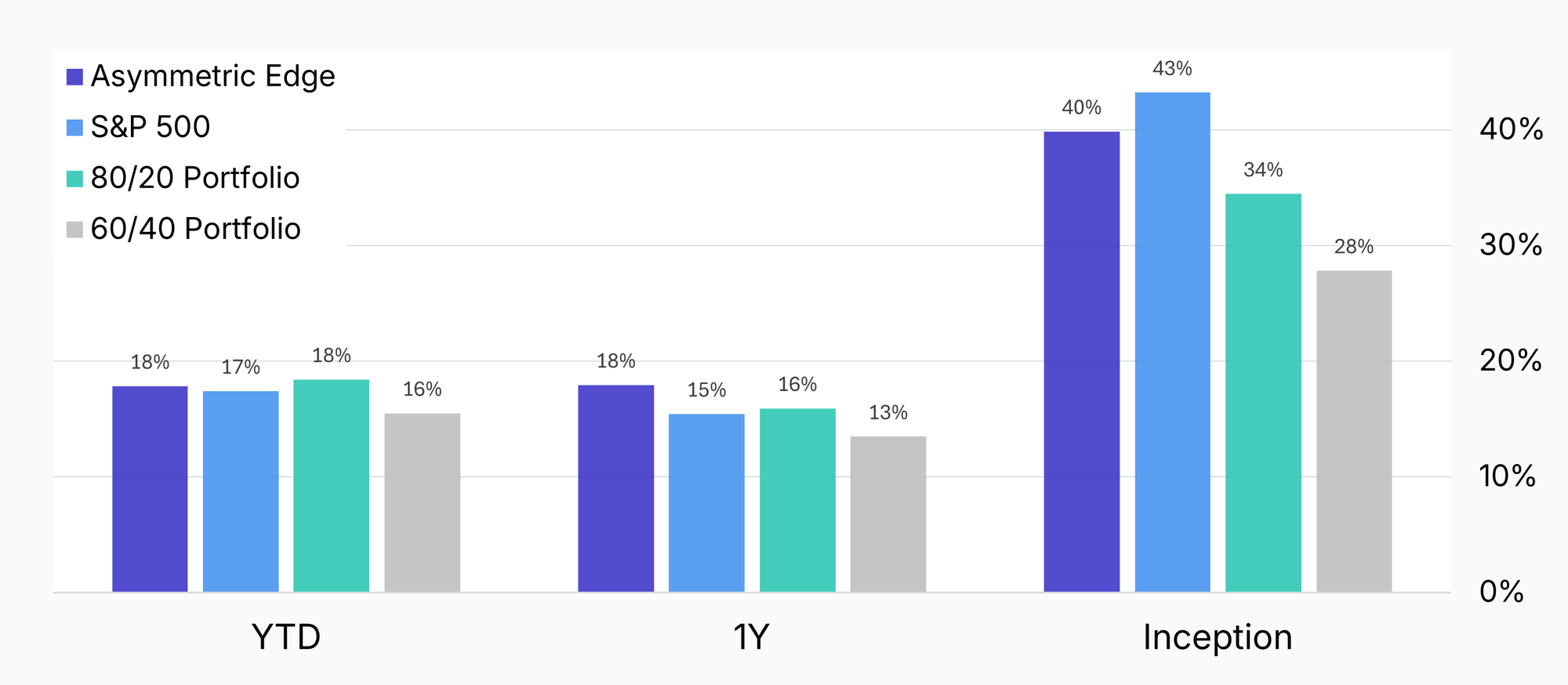
On a year-to-date basis, my strategy is slightly behind an 80/20 portfolio (17.85% versus 18.43%) and just ahead of the S&P 500 (17.85% versus 17.42%). Over the past 12 months it has outperformed all three benchmark portfolios by at least 2%. Since inception in January 2024, the S&P 500 leads my approach by 3.37%.
Performance Measures
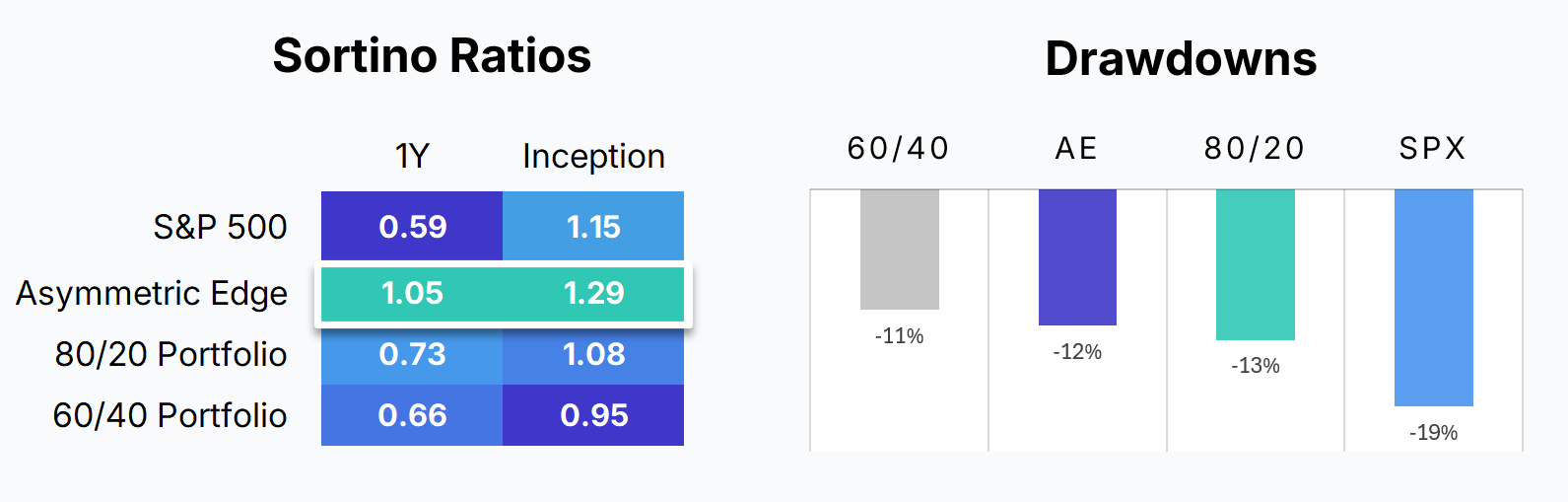
On both a trailing 12 month basis and since inception, its risk-adjusted results, as measured by the Sortino ratio, compare favorably with benchmarks.
The largest peak-to-trough decline for my portfolio was 11.95%. The only smaller decline came from the bond-heavy 60/40 portfolio at 10.56%. The S&P 500 saw a maximum drawdown of about 19%.
Charting the Growth of $10,000
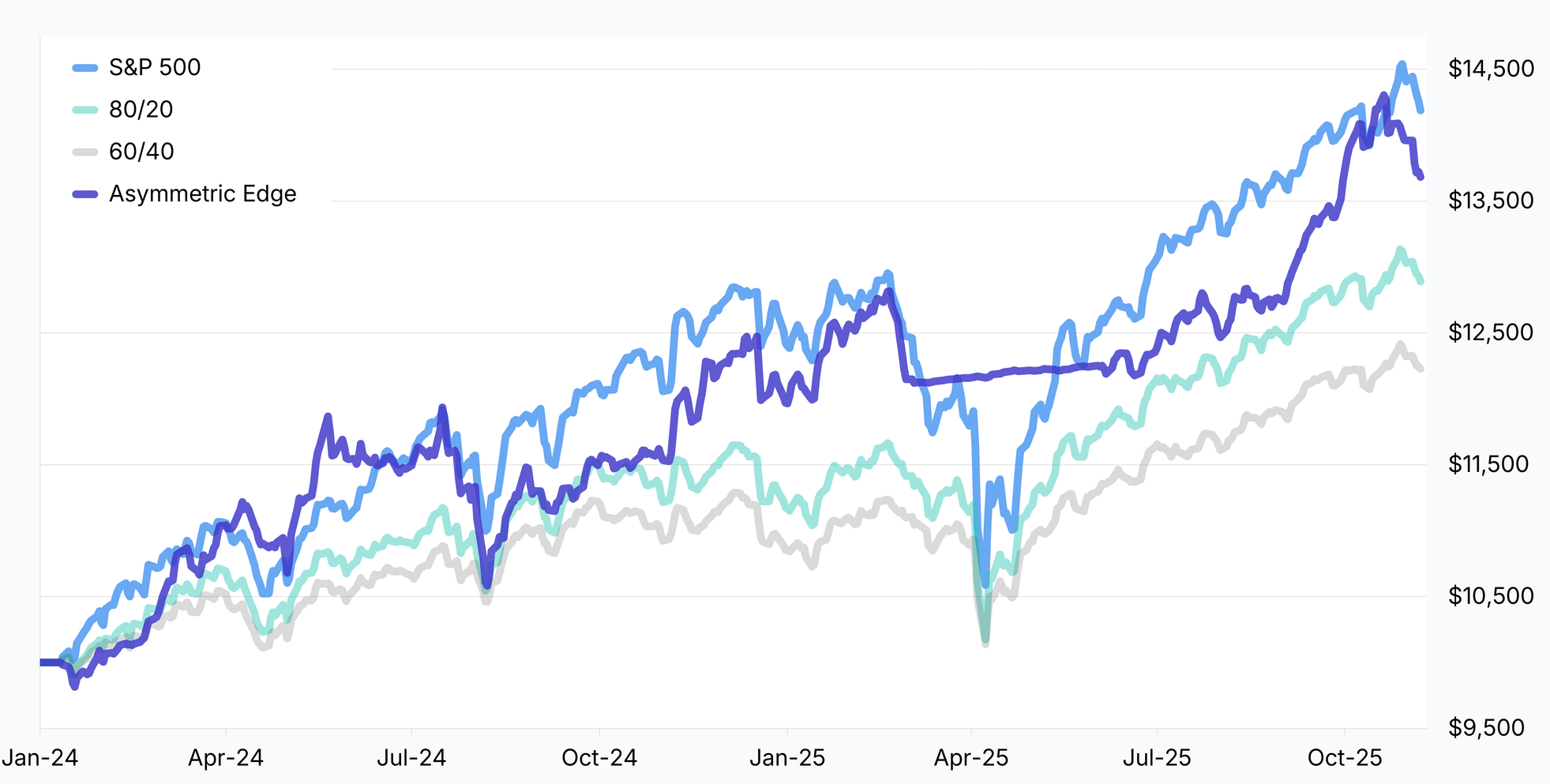
The chart shows how a hypothetical $10,000 investment would have grown in four portfolios since January 2024: the S&P 500, Asymmetric Edge, a 60/40 portfolio, and an 80/20 portfolio.
While my portfolio has not sidestepped every downturn, the path has been relatively smooth while largely keeping up with the S&P 500 over the past 22 months. The 60/40 and 80/20 portfolios lagged significantly.
Asymmetric Edge versus the S&P 500 this Year
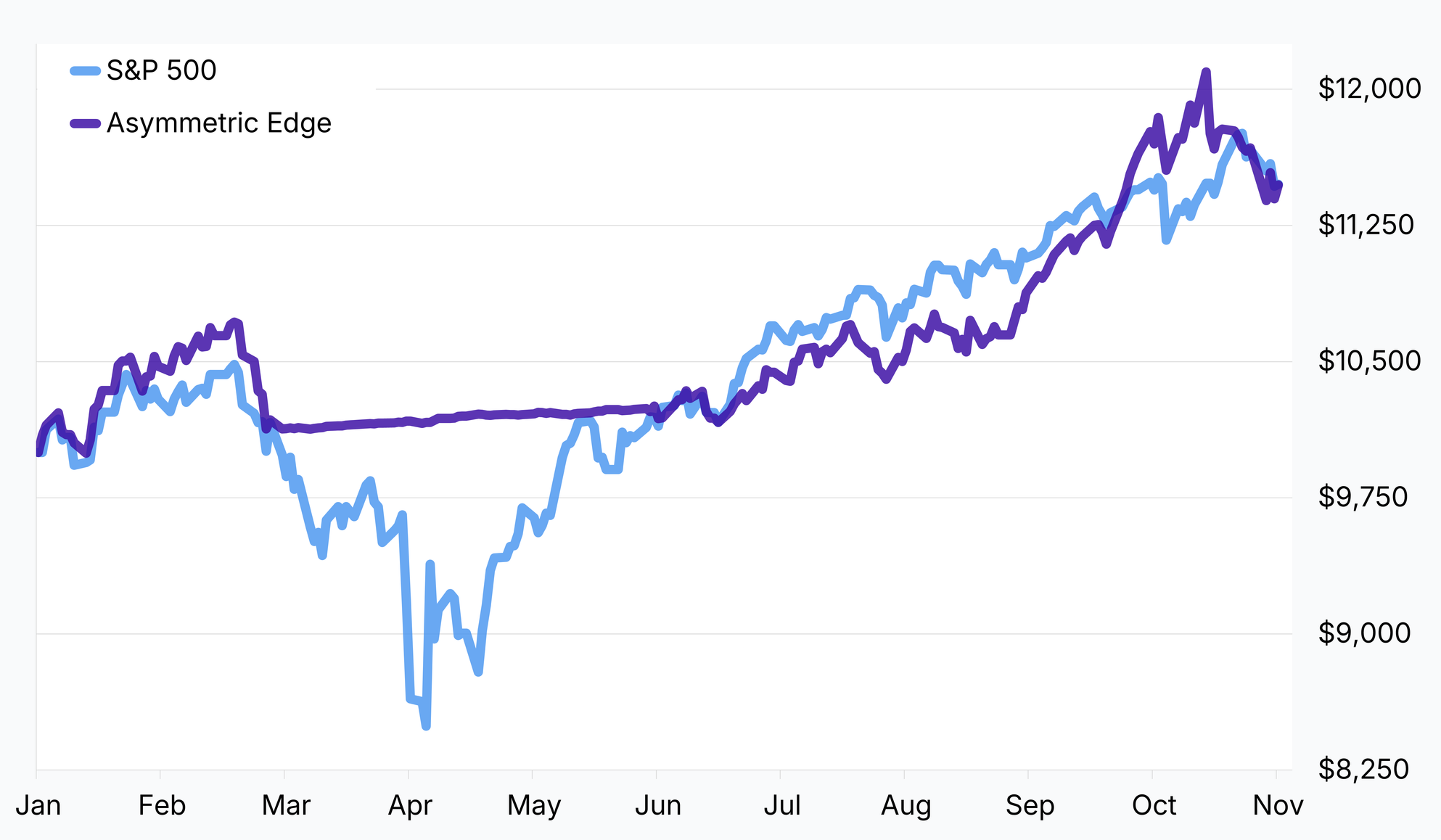
This chart zooms in on 2025 and compares the S&P 500 with Asymmetric Edge. After a pullback from the highs earlier in the year, my portfolio has held on to most of its gains and now sits roughly in line with the S&P 500 for 2025.
Gold Holding Strong
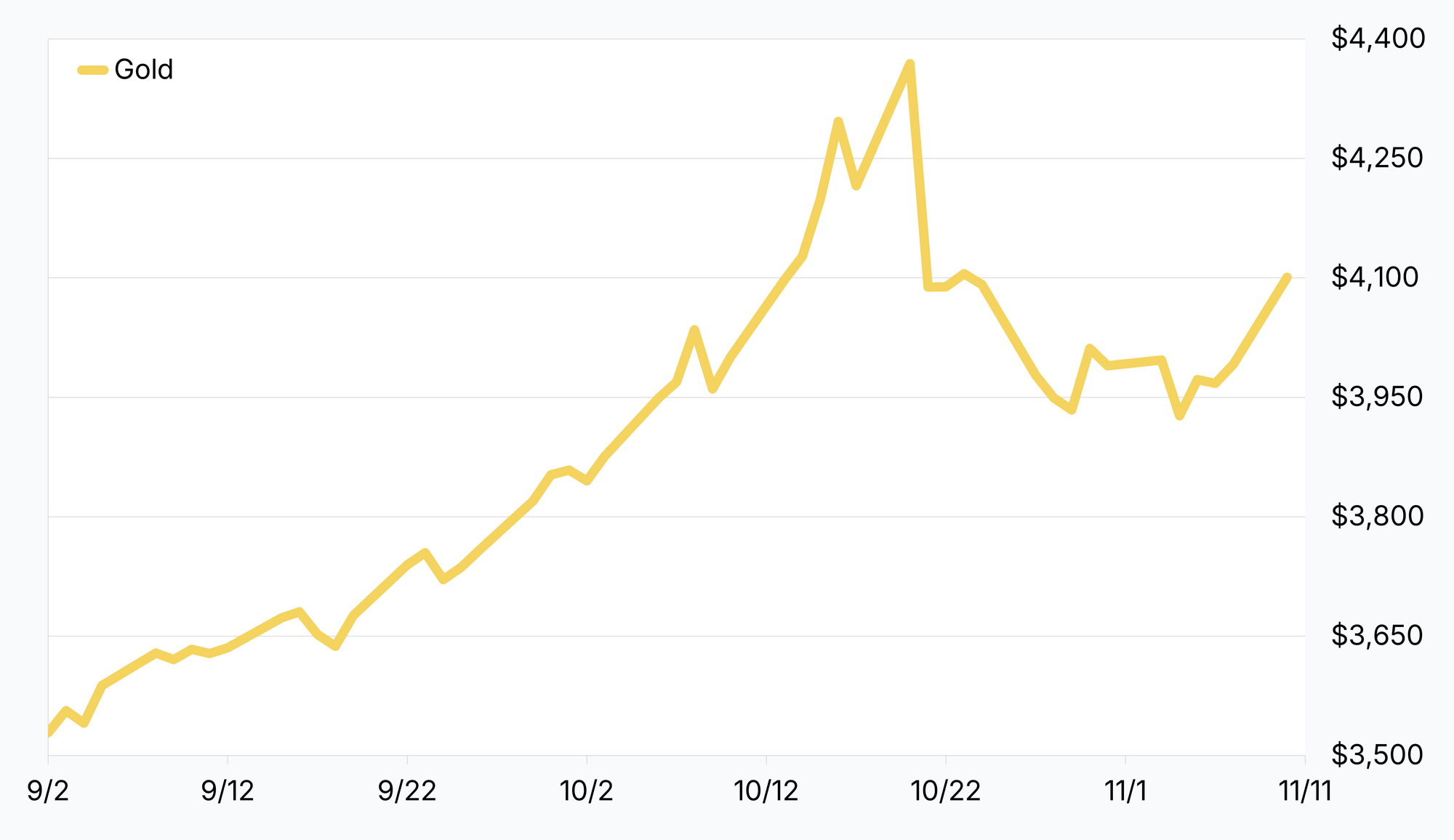
Starting October 21, gold fell rapidly from a peak of $4,381.48 on October 20 and declined as much as 11% at one point. Since then it has rebounded and its chart still looks good to me, with the potential for another run to new highs.
Trailing 1 Month Returns
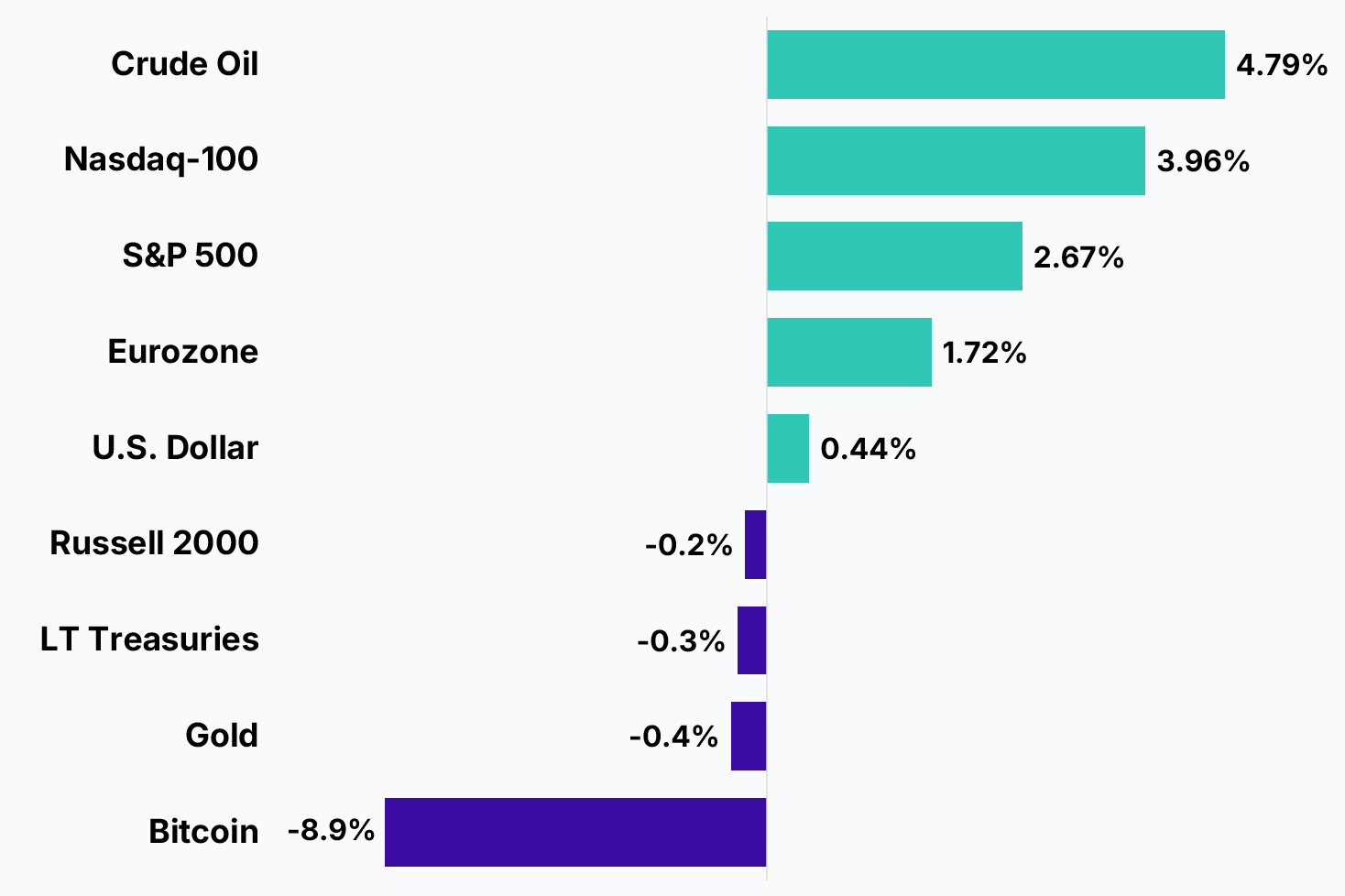
Bitcoin's decline continued as leveraged long positions were unwound. Diminished risk appetite and renewed ETF outflows contributed to forced selling in the cryptocurrency. The asset is proving to be a disappointment. If this is the end of the current bull run, it would deviate significantly from past cycles.
The Nasdaq-100 gained nearly 5%, helped by strong earnings from large technology and AI-related companies.
Gold spiked more than 13% by October 20 to a new all-time high, before pulling back sharply.
The U.S. dollar climbed nearly 2 percent, a meaningful move for a major currency. Higher interest rate expectations and global uncertainty supported demand for the dollar as a perceived safe haven.
The Russell 2000 index, which tracks smaller U.S. companies, reached new highs in October. The Federal Reserve’s rate cut provided a boost to credit-sensitive small caps and encouraged some rotation toward them for growth potential and valuations.
Year-to-Date Returns
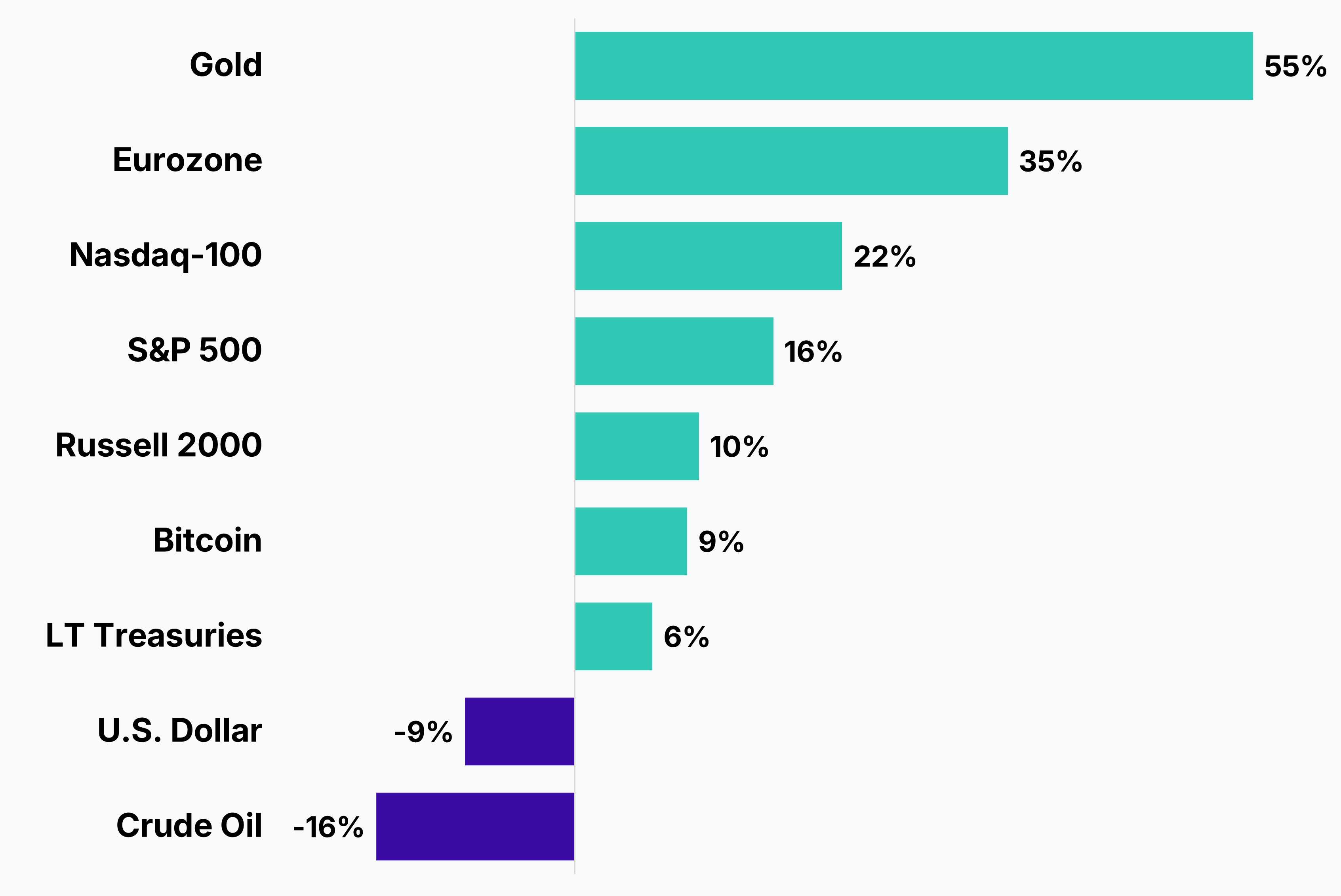
Even after the recent pullback, gold remains the strongest performer in 2025, up about 55% year-to-date.
Eurozone stocks still show gains near 34%, though momentum has slowed in recent months. Softer economic data, political uncertainty, and less exposure to high growth sectors have weighed on recent returns. In my own account I have shifted from Eurozone exposure toward U.S. markets, which have led in recent months. Strong corporate earnings, AI-linked investment, and an easier rate outlook have provided support for U.S. technology and small cap stocks.
While bitcoin is down around 18% from its peak on October 6th, it still landed a spot in my strategy's top 4 assets as ranked by relative strength. Should momentum continue to falter, I will likely drop bitcoin from the portfolio in December.
Portfolio Shifts
Small Caps Show Signs of Life
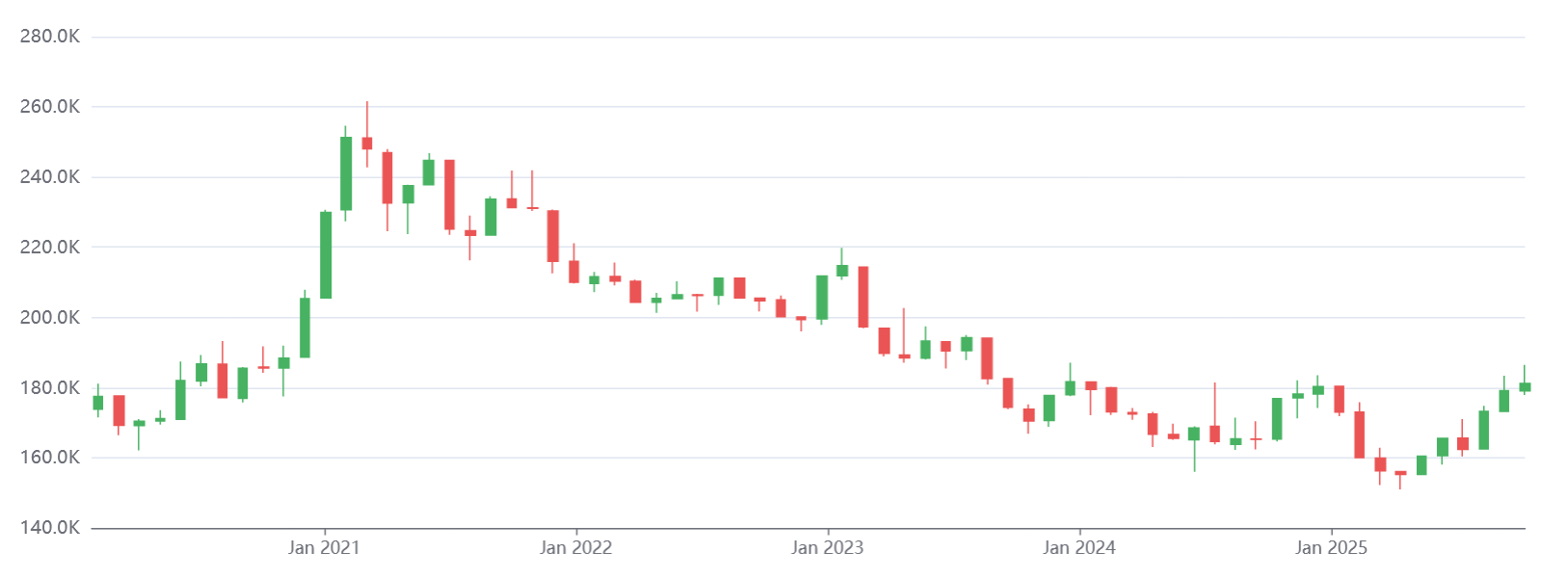
Just as with most things in markets, small cap stocks shine in certain periods and lag during others. The chart above tracks the results of a strategy that goes long on small caps and shorts large caps. You can see a surge of outperformance beginning in 2020 and peaking early 2021. It looks like after about 4 years of underperformance, small caps might be turning a corner and starting to outperform large caps.
💼 Large caps are very big, established companies, with market values more than $10 billion, and they often have global operations and revenue.
My Portfolio Allocations for November
| Asset | Ticker | Weight | Purpose |
|---|---|---|---|
| 🟨 Gold | GLD | 41.2% | Inflation & crisis hedge |
| 🔷 Russell 2000 | IWM | 22.6% | Small-cap US exposure |
| 💻 Nasdaq | QQQ | 22.7% | Growth from US tech leaders |
| 🟠 Bitcoin | IBIT | 13.5% | Speculative growth |
The portfolio going into November saw significant changes. While my rotation out of Eurozone stocks and into U.S. small caps concentrates equity positions in the U.S., gold and bitcoin remain as U.S. dollar hedges and the Russell 2000 provides a nice counterbalance to the large cap, tech-heavy Nasdaq.
Deep Dive: Cognitive Biases and Distortions

Successful investing often depends more on psychology than on picking the "right" investments. Many people struggle to stick with a plan when their money is on the line.
A big part of this is the lack of awareness that investors have of their cognitive biases and cognitive distortions. These mental habits can color how we see markets and lead us to make mistakes.
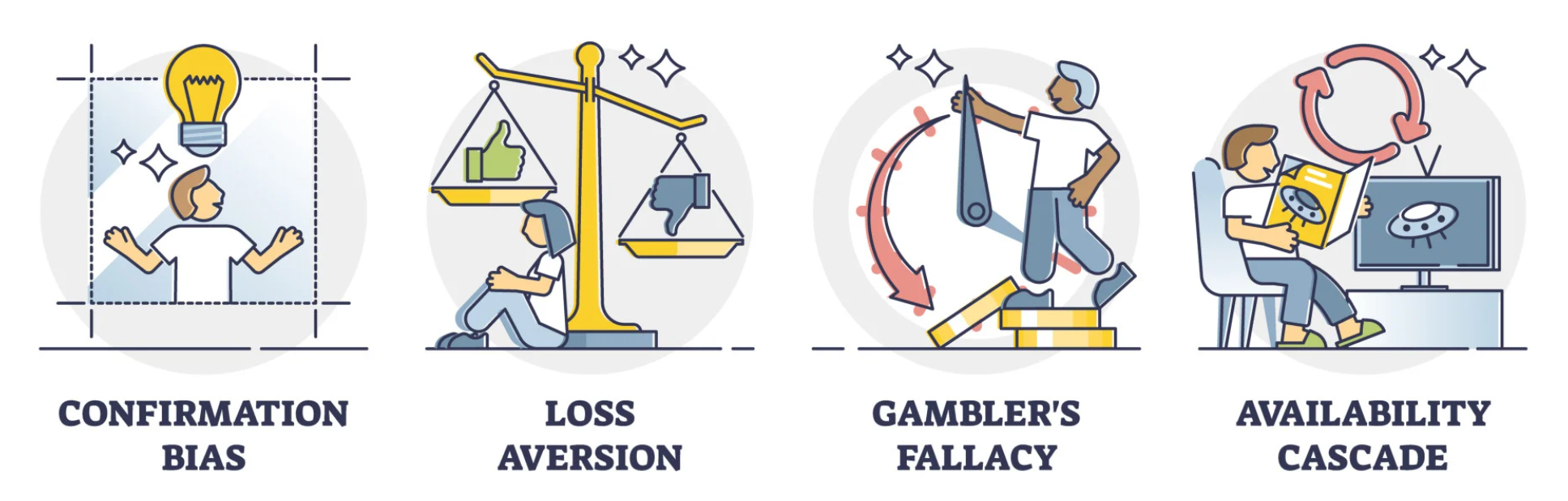
Cognitive biases are mental shortcuts or patterns of thinking that help the brain make quick decisions but can sometimes lead to errors in judgment.
One example is loss aversion, where losing $1 feels about twice as painful as the pleasure of gaining $1. This bias can distort reality by heightening fear and creating the urge to act, such as buying or selling, when it might be better to stay still.
Cognitive Distortions
Cognitive distortions are a little different. They are patterns of thinking that twist or misinterpret reality in negative ways. These automatic thoughts make situations seem worse, more personal, or more hopeless than they really are. In simple terms, they are mental habits that cause people to see things inaccurately.
Cognitive distortions are common, but they can become problematic when left unchecked, especially when it comes to money and investing. While there is a long list of possible distortions, becoming aware of a few key ones has helped me immensely with my own investing decisions. Awareness alone can make a real difference by giving you an extra moment to pause and catch yourself between stimulus and response.
💭 "Should" Statements
This distortion involves believing that you, others, or the market should behave in a certain way and feeling frustrated when those expectations are not met. It often creates rigid mental rules about how things are supposed to unfold and leads to disappointment when events work out differently.
Example: “We just got a bad jobs report, stocks have got to tank.” When the market fails to match this expectation, your frustration can lead to unnecessary trades or emotional decision-making.
Tip: When you notice a “should” thought, ask yourself whether it reflects reality truth or simply your own personal rule about how things ought to be.
🎯 Personalization
Personalization is the tendency to interpret market movements as directly revolving around you; that they directly reflect on your abilities, intelligence, or worth. This distortion can make markets shifts feel like personal attacks.
Example: Thoughts like “The market is against me” or “I always get burned” blur the line between your identity and external events. This mindset often leads to shame, frustration, or revenge trading that moves you further from rational investing. In truth, the market is indifferent to any individual. Recognizing this helps create distance between your self-worth and your investment results.
Tip: When you catch a personalized thought, reframe it as, “The market moved. My job is to respond with my plan, not my ego.”
⚠️ Catastrophizing
Catastrophizing involves expecting the worst possible outcome, even when the evidence does not support it. This distortion amplifies fear and fuels an exaggerated sense of danger in response to normal fluctuations.
Example: A small dip in prices can suddenly feel like the start of a crash, or one bad trade can convince you that your investing future is ruined. These exaggerated thoughts drive anxiety, panic selling, or hesitation to take reasonable risks.
Tip: When your mind jumps to a worst-case scenario, pause and ask, “What is the most likely outcome here, based on facts instead of fear?” Grounding yourself in data rather than emotion helps restore perspective and balance.
Conclusion
In the end, successful investing is less about predicting the market and more about managing yourself. Recognizing your own cognitive biases and distortions creates the mental space to make decisions based on strategy instead of emotion. The market will always be unpredictable, but self-awareness allows you to stay steady, stick to your plan, and let time and discipline do the work.
This newsletter is for informational purposes only and should not be considered as investment advice or a recommendation of any particular security, strategy, or investment product. The information contained herein has been obtained from sources believed to be reliable, but its accuracy and completeness are not guaranteed. Opinions expressed are subject to change without notice. This material is not an offer to sell or a solicitation of an offer to buy any security.
The author may hold positions in securities mentioned in this newsletter. All expressions of opinion are subject to change without notice in reaction to shifting market conditions. Data contained herein from third-party providers is obtained from what are considered reliable sources. However, its accuracy, completeness, or reliability cannot be guaranteed.
Investment involves risk, including possible loss of principal. No investment strategy or risk management technique can guarantee returns or eliminate risk in any market environment.
This content is provided solely for the personal use of the intended recipient. Any unauthorized copying, forwarding, distribution, or sharing of this material, whether in whole or in part, is prohibited without the prior written consent of the author. If you are not the intended recipient of this communication, please delete it and refrain from disseminating, distributing, or copying its contents.