Records on Top, Rotation Underneath
U.S. stocks are back in the portfolio with the S&P 500 recently printing new records. The strategy still leads its balanced benchmarks comfortably, but the deeper story this month is what the basket of alternatives has historically done during the worst stock market drawdowns since 1995.


At a Glance
The Asymmetric Edge strategy is up 18.98% year-to-date through May 19, nearly three times the return of an 80/20 portfolio (+6.62%) and well ahead of the S&P 500 (+7.89%). Since inception in January 2024, the strategy has returned 67.68%, with a maximum drawdown less than half that of the S&P 500.
This issue covers a busy month: U.S. stocks back in the lineup for the first time since January, gold out after a twenty-month run, fresh S&P 500 records mid-May, and a deep dive on how the strategy's basket of alternatives has performed during major stock market drawdowns.
📌 This newsletter explains how I invest my own money, using a simple portfolio of four ETFs. I share what I hold and why, so readers can see one real world approach in action.
Market Movement Summary
- 🏆 The S&P 500 hit a fresh record of 7,501 mid-May, then sold off sharply after 10-year Treasury yields hit a one-year high
- 🔄 U.S. stocks back in the portfolio (the Nasdaq-100 and Russell 2000) for the first time since January, replacing Japan hedged equity and gold
- 🔥 April CPI jumped to 3.8%, the highest annual reading since May 2023, on a surge in gasoline prices
- 🥇 Gold's 20-month run contributed roughly 17.85 percentage points to portfolio returns before getting booted from the top four ETFs
Portfolio Shifts
- The Nasdaq-100 enters with a 27.60% allocation and the Russell 2000 with 23.20%, restoring U.S. equity exposure for the first time since January
- Gold and Japan hedged equity dropped out, ending a twenty-month run for gold and a two-month run for Japan
Theme of the Month
The return a portfolio generates specifically when traditional markets are falling, rather than as a side effect of long-term growth. A portfolio with crisis alpha holds assets that respond differently to stress, like anti-beta, commodities, gold, and long Treasuries. It is the closest thing in investing to an insurance policy, designed to pay off precisely when other parts of the portfolio struggle.
One Number That Matters
In a historical reconstruction covering the ten worst S&P 500 drawdowns since June 1995, at least one alternative asset in the strategy's basket produced a positive return while stocks were falling.
Market Moves
Portfolio & Benchmark Returns
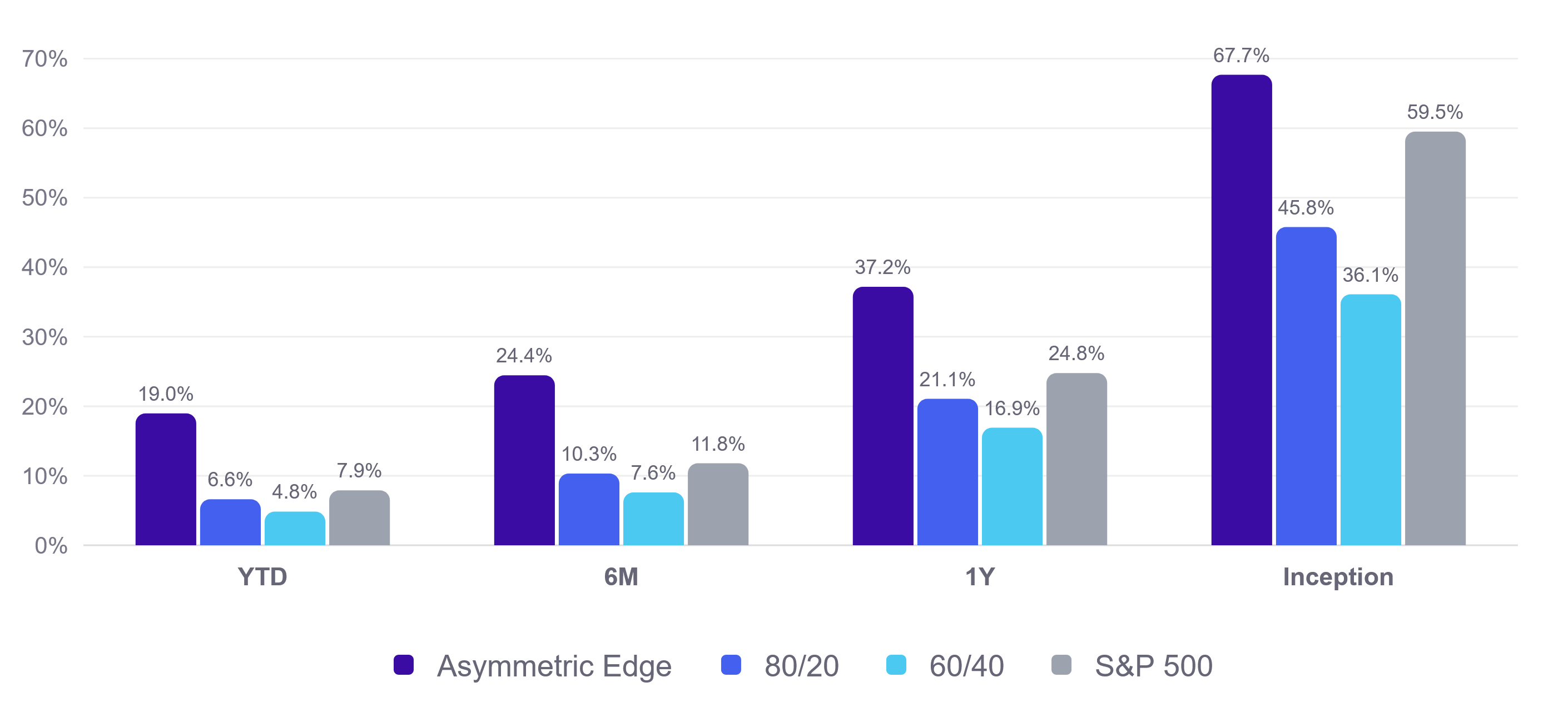
The strategy is beating both 60/40 (AOR) and 80/20 (AOA) benchmarks across every time period shown: year-to-date, trailing 6 months, trailing 12 months, and since inception. The same is true against the S&P 500 across all four windows, a shift from last month when U.S. stocks were ahead on the 1-year view.
Charting the Growth of $10,000
Year-to-Date
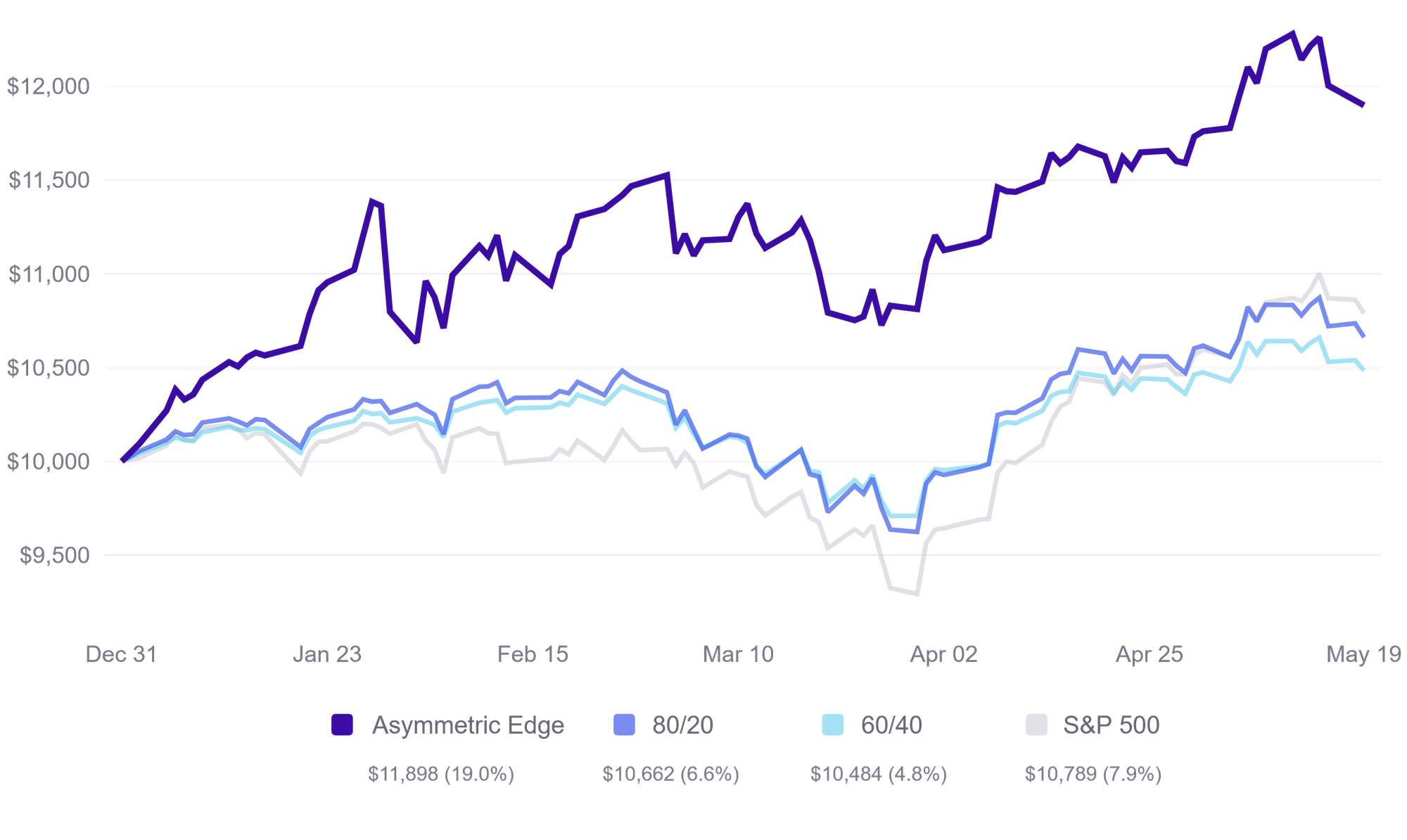
A hypothetical $10,000 invested at the start of the year would now be worth $11,898 in the strategy, versus $10,662 in an 80/20 portfolio, $10,484 in a 60/40, and $10,789 in the S&P 500.
Year-to-Date Asset Class Returns
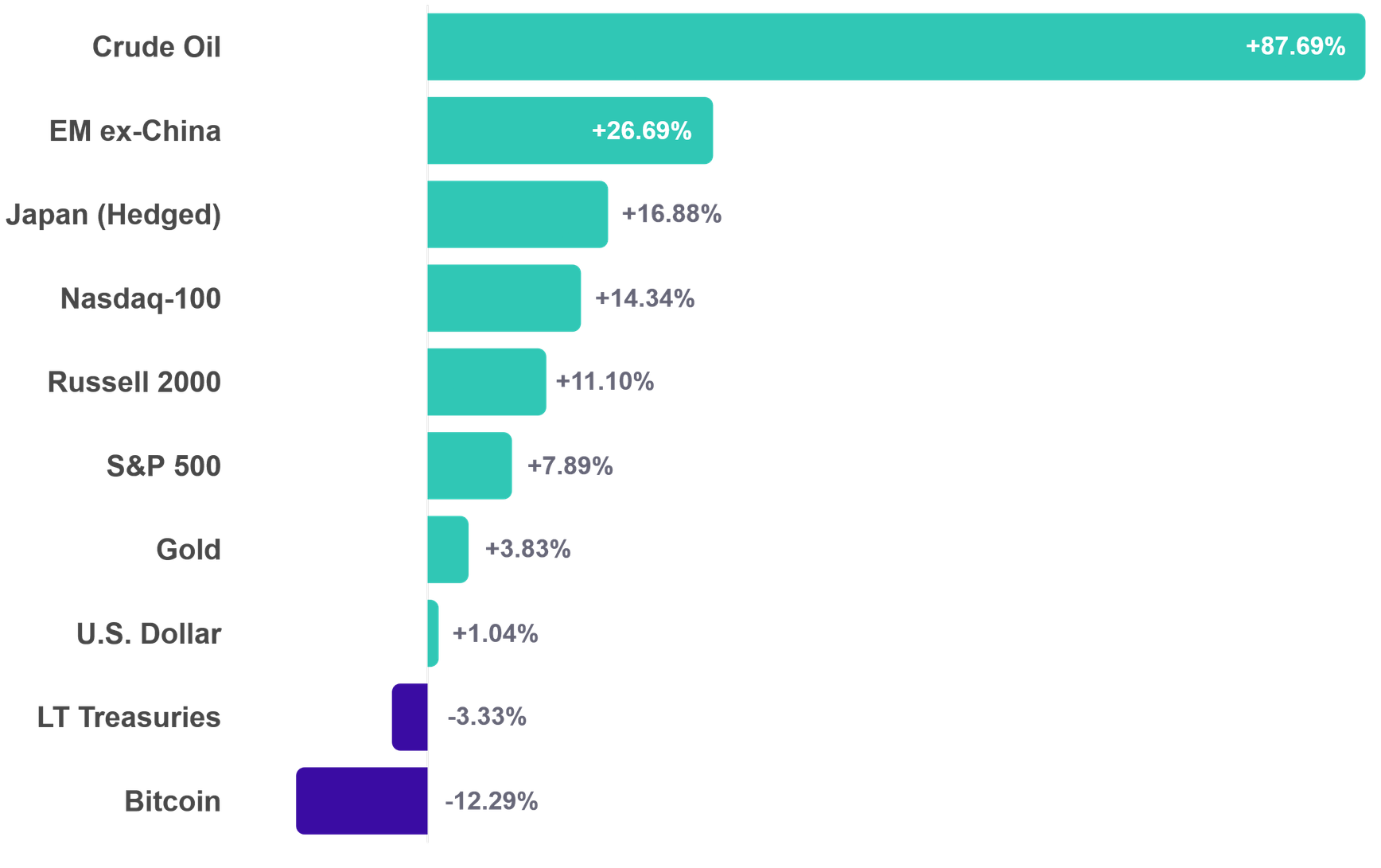
Crude oil still leads at +87.69% YTD on the continuing Hormuz disruption, followed by emerging markets ex-China (+26.69%), Japan hedged equity (+16.88%), the Nasdaq-100 (+14.34%), and the Russell 2000 (+11.10%). The S&P 500 sits at +7.89% and gold at +3.83%. Bitcoin is the YTD laggard at -12.29%.
Gold's Twenty-Month Run, By the Numbers
Gold left the portfolio at the end of April after a 608-day run, the longest the strategy has ever held the asset. On average, gold was about 30% of the portfolio across this period, and the portfolio itself returned 45.88%. Gold contributed roughly 17.85 percentage points of that, meaning about 39% of the gains came from an asset that was only 30% of the average weight. September 2025 alone added +4.53 percentage points, and January 2026 added another +4.18.
Gold's monthly contribution to portfolio return
Monthly contribution is start-of-day GLD weight times daily return. Portfolio TWR anchored to Fidelity (deposits excluded). GLD prices from Yahoo Finance. Pre-tax.
Gold's worst contribution month was March 2026 at -2.12 percentage points. By then the strategy had already trimmed the position from over 40% in late 2025 down to about 19%, so the damage was contained. Removing gold this month wasn't a verdict on the asset. Gold simply lost its spot in the top-four rankings. If gold's momentum picks up again, it will come back.
Inflation, Jobs, and the Fed
April CPI rose 0.6% on the month for an annual rate of 3.8%, the highest reading since May 2023, driven largely by a 28.4% year-over-year jump in gasoline. Gas now averages $4.46 a gallon.
April payrolls came in at +115,000, well above the 55,000 to 62,000 consensus, with unemployment at 4.3%, and the Conference Board cut its 2026 U.S. GDP forecast to 1.6%. The Fed is now widely expected to leave rates unchanged through year-end, with markets pricing in a 40% probability of a rate hike before the next cut.
Portfolio Allocations for May
| Asset | Ticker | Weight | Purpose |
|---|---|---|---|
| 💻 Nasdaq-100 | QQQ | 27.60% | Growth from U.S. tech leaders |
| 🛢️ Active Commodities | HGER | 26.46% | Broad commodity exposure with inflation sensitivity |
| 🔷 Russell 2000 | IWM | 23.20% | Small-cap U.S. exposure |
| 🌏 EM ex-China | EMXC | 22.74% | Emerging markets diversification without China risk |
This is the biggest portfolio change since the rotation out of U.S. stocks in February. The Nasdaq-100 and Russell 2000 are in, gold and Japan hedged equity are out, and active commodities and emerging markets ex-China were trimmed to make room.
Where the Money Moved
The May rebalance was a substantial reshape. The table below shows each position's pre-rebalance drift weight and its May target.
| Asset | Pre-Rebalance | May Target | Change |
|---|---|---|---|
| 💻 Nasdaq-100 (QQQ) | 0.00% | 27.60% | +27.60% (new) |
| 🔷 Russell 2000 (IWM) | 0.00% | 23.20% | +23.20% (new) |
| 🛢️ Active Commodities (HGER) | 29.80% | 26.46% | -3.34% |
| 🌏 EM ex-China (EMXC) | 28.90% | 22.74% | -6.16% |
| ⛩️ Japan Hedged Equity (DXJ) | 23.15% | 0.00% | -23.15% (exit) |
| 🟨 Gold (GLD) | 18.15% | 0.00% | -18.15% (exit) |
Gold's exit caps a run that drove much of 2025's outperformance, but its momentum has gone flat to negative since the January peak and active commodities overtook it in the rankings. Japan hedged equity lost the equity-basket ranking when the Nasdaq-100 and Russell 2000 broke higher. The trims to commodities and emerging markets were standard rebalancing back toward ranking-implied weights.
Deep Dive: No Single Asset Saves You, the Rotation Does

The premise
Not every crisis looks the same. In 2008, long-term Treasuries did fine and gold held its own. In 2022, both stocks and bonds fell together and commodities were the only thing that worked. In the dot-com crash, neither bonds nor commodities mattered much, but anti-beta strategies (which short high-volatility stocks and buy low-volatility ones) nearly doubled. Each crisis had its own hero.
This is the central insight behind the strategy's basket of alternatives: anti-beta (BTAL), active commodities (HGER), long Treasuries (TLT), and gold (GLD), plus T-bills (BIL) for capital preservation. In a backtest covering the ten worst S&P 500 drawdowns since June 1995, at least one of those alternatives produced a positive return in every single one. The lead asset was rarely the same one twice in a row.
The historical record
Here is how the ten worst stock market drawdowns since 1995 break down:
- Anti-beta (BTAL) led in three equity-unwind episodes. The dot-com crash is the standout: a thirty-month, 42% S&P decline during which the anti-beta sleeve returned roughly 94% and the strategy backtest gained about 31%.
- Active commodities (HGER) led in three mostly inflation-tinged selloffs. The 2022 bear market is the clearest example, with commodities up about 16.5% while the S&P fell 19%.
- Long Treasuries (TLT) led in two fast flight-to-safety panics: COVID-19 and the 1998 Russia / LTCM crisis.
- Gold (GLD) led in only two episodes, but one of them was the deepest crisis of all: the Great Recession, where gold returned +21.7% while the S&P fell 49%. It also led the 2025 tariff selloff (+13.0%).
A much shallower ride
Peak-to-trough drawdowns during the 10 worst S&P 500 sell-offs since June 1995
Maximum peak-to-trough decline within each crisis window, monthly total-return data. Strategy returns from a backtest of a simplified Asymmetric Edge strategy; see methodology note below. Past performance does not guarantee future results.
The broader backtest going back to 1995 also includes some shorter, shallower equity dips where no alternative cushioned the blow. The protection is built for sustained drawdowns, not every brief wobble. T-bills (BIL) never led a window. They are capital preservation, not a return generator.
A note on methodology: most of these alternative ETFs launched well after 1995, so the backtest relies on backfill data for the earlier years. BTAL (launched 2011) uses the fund manager's published index backtest of the same anti-beta strategy. HGER (launched 2022) uses the underlying index it tracks, with a synthetic series extending it further back. TLT (launched 2002) uses a long-duration government Treasury mutual fund (VUSTX) as a proxy. GLD (launched 2004) uses spot gold prices. Backtested and proxy-based results have inherent limitations and may not reflect what would have been achieved if the actual funds had traded during those periods.
The 60/40 honest comparison
A traditional 60/40 portfolio reduced the depth of every one of the ten drawdowns relative to a pure S&P 500 position. That is a real benefit. But the reduction was partial. In the Great Recession, the 60/40 fell about 31% while the S&P fell 49% and the strategy backtest fell 5%. In the dot-com crash, the 60/40 fell about 20% while the S&P fell 42% and the strategy backtest fell 4%. In 2022, the 60/40 fell about 17.5% while the S&P fell 19% and the strategy backtest fell 1%, because that was the year bonds failed to hedge. The 60/40 softened crises. The basket of alternatives very nearly sidestepped them.
Where the portfolio sits today
A reasonable reader might ask: if the basket of alternatives is so important, why is 51% of the portfolio now in U.S. stocks? Because none of the alternatives is showing the momentum the rankings require for a top-four slot right now. The strategy holds what the data says to hold. The four alternatives (BTAL, HGER, TLT, GLD) are still in the basket and still being ranked every month. If any climbs back into the top four, the strategy will rotate. That is the whole point of a momentum system: it does not need to predict the next crisis, it just needs to follow the data into whatever is working.
Wrap Up

May has been a study in contrasts: fresh S&P 500 records mid-month then a sharp pullback on a one-year high in the 10-year Treasury yield, gold finally losing its top-four slot after twenty months as the portfolio's anchor, and U.S. stocks coming back in. The portfolio is positioned for what is working, with the hedges that have worked in the past standing by if conditions change.
Thanks for reading. If you have questions or feedback, I would love to hear it.

Disclaimer & Disclosure
This newsletter is for informational purposes only and does not constitute financial advice, investment recommendations, or an offer to sell or buy any securities. The content is published as a journal of the author's personal investment activities and is intended for a general audience.
No Investment Advice: The author is not a financial advisor. You should not treat any opinion expressed herein as a specific inducement to make a particular investment or follow a particular strategy, but only as an expression of opinion.
Risk Warning: Investment involves risk, including the possible loss of principal. Past performance is not indicative of future results. No investment strategy or risk management technique can guarantee returns or eliminate risk in any market environment.
Data & Accuracy: Information contained herein has been obtained from sources believed to be reliable, but its accuracy and completeness are not guaranteed. All expressions of opinion are subject to change without notice in reaction to shifting market conditions.
Positions: The author currently holds positions in the securities mentioned in this newsletter. The author may buy or sell these securities at any time without notice.
Copyright: This content is provided solely for the personal use of the subscriber. Any unauthorized copying, forwarding, or distribution of this material is prohibited without prior written consent.