What Six Selloffs Say About a Bad Friday
The S&P 500 had its worst day since October on Friday, and the strategy fell even harder. It is still up 18.8% year to date, more than double an 80/20 portfolio. Inside: what six past selloffs say about riding the first leg down.


At a Glance
The Asymmetric Edge strategy is up 18.8% year to date through June 5, more than double an 80/20 portfolio (+7.4%) and well ahead of the S&P 500 (+8.5%), even after the worst day for U.S. stocks since October. Since inception in January 2024, the strategy has returned 67.4%, ahead of all three benchmarks.
This issue covers a sharp drop in markets. Fresh S&P 500 records at the start of June gave way to the worst single day for U.S. stocks since October on Friday the 5th. The portfolio holds the same four ETFs as last month. The deep dive in this issue reconstructs how the strategy would have behaved going into past selloffs while carrying equity-heavy positioning similar to today's.
📌 This newsletter documents how I invest my own money with a simple, rules-based strategy. The aim is to match a traditional balanced portfolio with shallower drawdowns, and I share what I hold and why so you can watch it play out.
Market Movement Summary
- 📉 The S&P 500 fell 2.6% on Friday, June 5, its worst day since October 10 and its first losing week in ten
- 💼 A strong May jobs report (payrolls up 172,000 against expectations near 80,000, unemployment at 4.3%) lifted rate-hike expectations and sparked the selloff
- 🔥 April CPI came in at 3.8% year over year, a three-year high
- 🛢️ Crude oil pulled back about 20% from its 2026 peak on optimism around a U.S.-Iran ceasefire
- 🔄 The portfolio held steady with the same ETFs as last month. Small caps and emerging markets took the brunt on Friday, while active commodities held up best
Portfolio Shifts
- No rotation this month. The same four ETFs carry into June: the Nasdaq-100, active commodities, the Russell 2000, and emerging markets ex-China.
- The four alternatives that make up the defensive basket (defensive equity, long Treasuries, gold, and short-term Treasuries) are all outside the top four, so no defensive sleeve is active.
Theme of the Month
A momentum strategy does not call tops. It follows trends, which means it tends to ride the first part of a decline before the monthly signal cuts exposure. The cost is real on the way down. The payoff is that the strategy never has to predict a turn, it only has to respond once the trend actually breaks.
One Number That Matters
The S&P 500's drop on Friday, June 5, its worst single day since October 10 and its first losing week in ten. One day does not make a trend. This could stay a single bad session in an uptrend, or it could turn into the first leg of something larger, in which case the strategy would ride part of the way down before the monthly rebalance can respond. (Source: Associated Press.)
Market Moves
Portfolio & Benchmark Returns
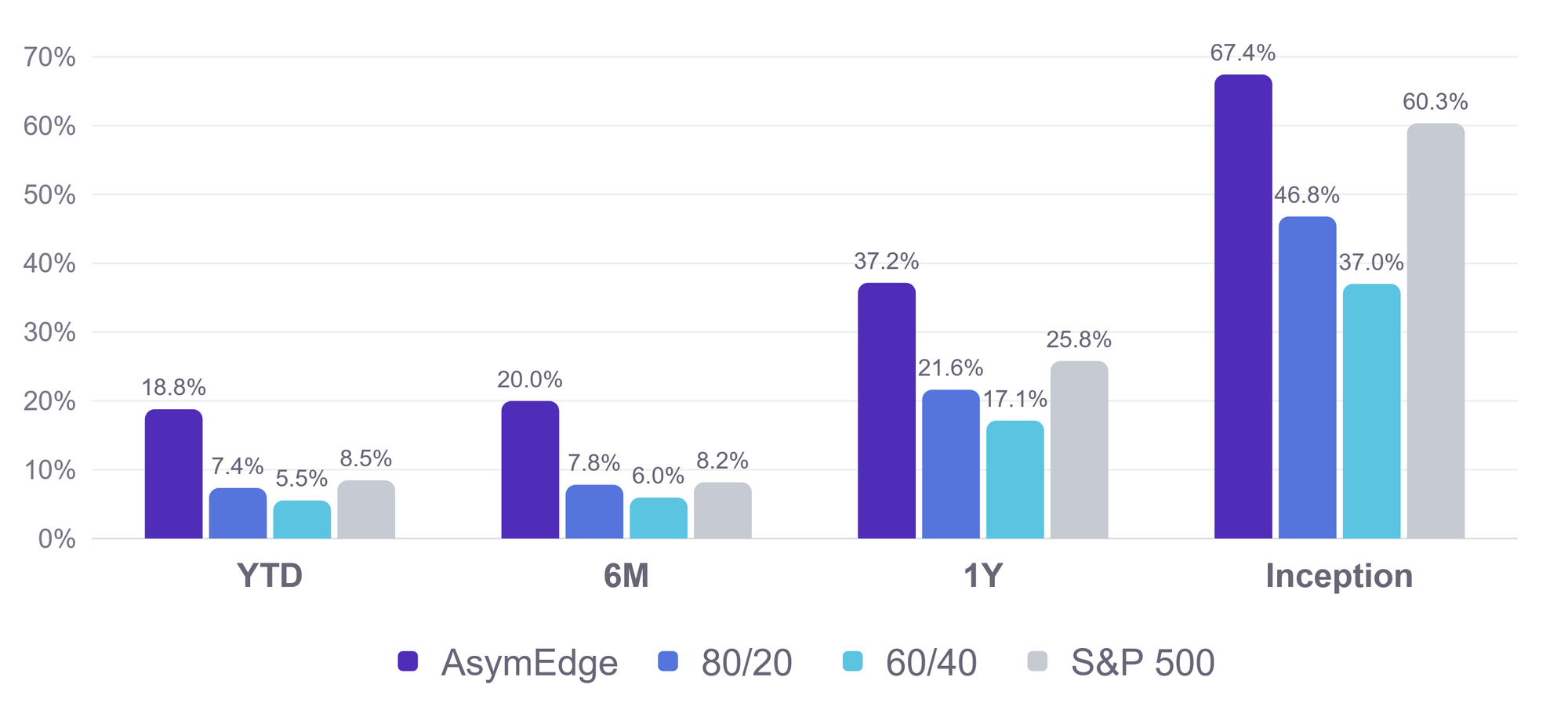
The strategy leads every benchmark across all four lookback periods. Year-to-date it is up 18.8%, against 8.5% for the S&P 500, 7.4% for an 80/20 portfolio, and 5.5% for a 60/40. Over the trailing year it is up 37.2%, ahead of the S&P's 25.8%. Since inception it has returned 67.4%, compared with 60.3% for the S&P, 46.8% for the 80/20, and 37.0% for the 60/40.
Friday cost the strategy more than it cost the benchmarks, which is what I would expect for a portfolio with roughly three-quarters of its weight in equities on a broad risk-off day. The lead built up earlier in the year absorbed the hit. The goal is not to avoid every down day. It is to match or beat a balanced portfolio with shallower drawdowns over time.
Charting the Growth of $10,000
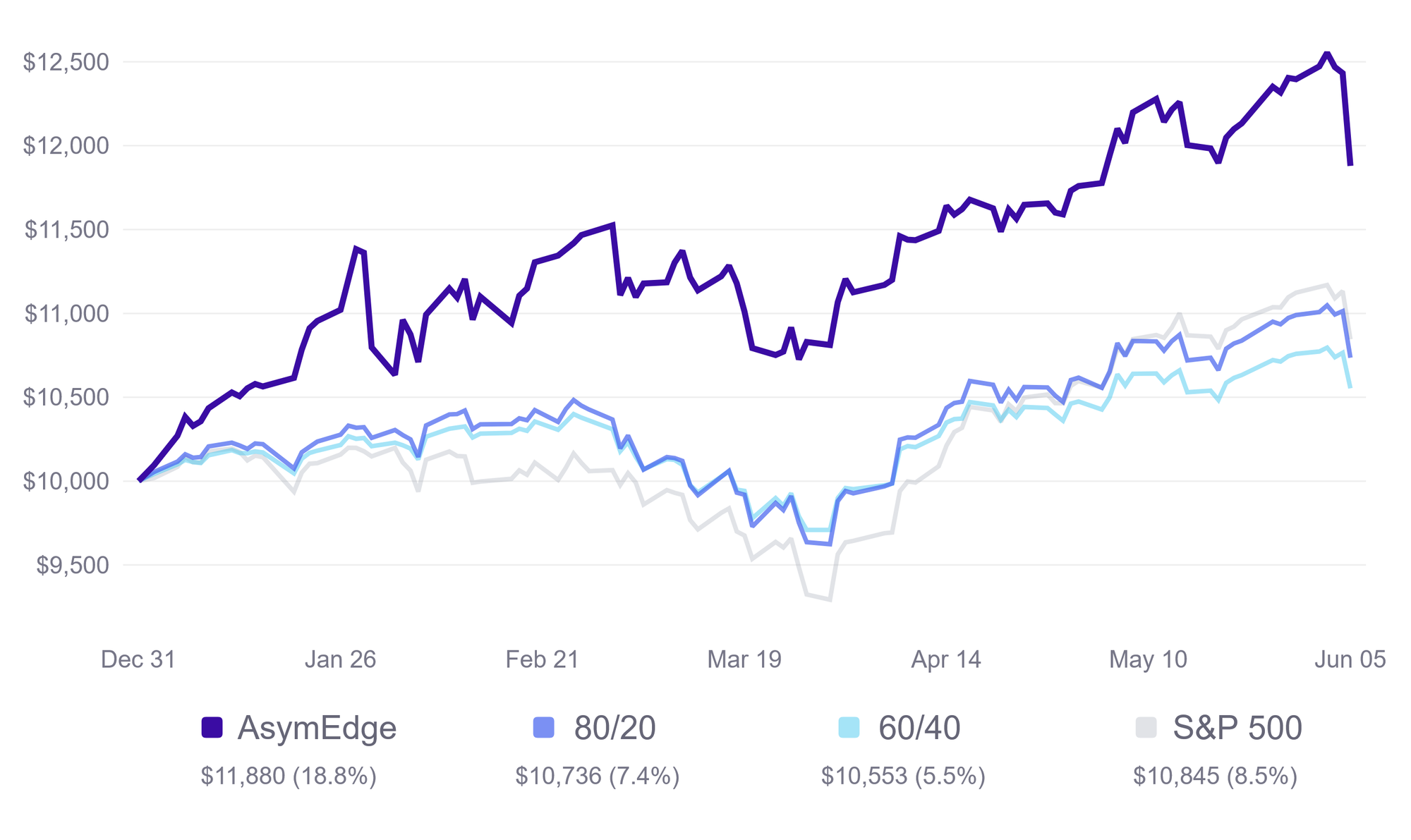
A hypothetical $10,000 invested at the start of the year would be worth $11,880 in the strategy through June 5, against $10,845 in the S&P 500, $10,736 in an 80/20 portfolio, and $10,553 in a 60/40. The strategy ran ahead in January and February, gave a little back in the late-March selloff, and rebuilt the lead through the spring before Friday clipped the top off the line.
Year-to-Date Asset Class Returns
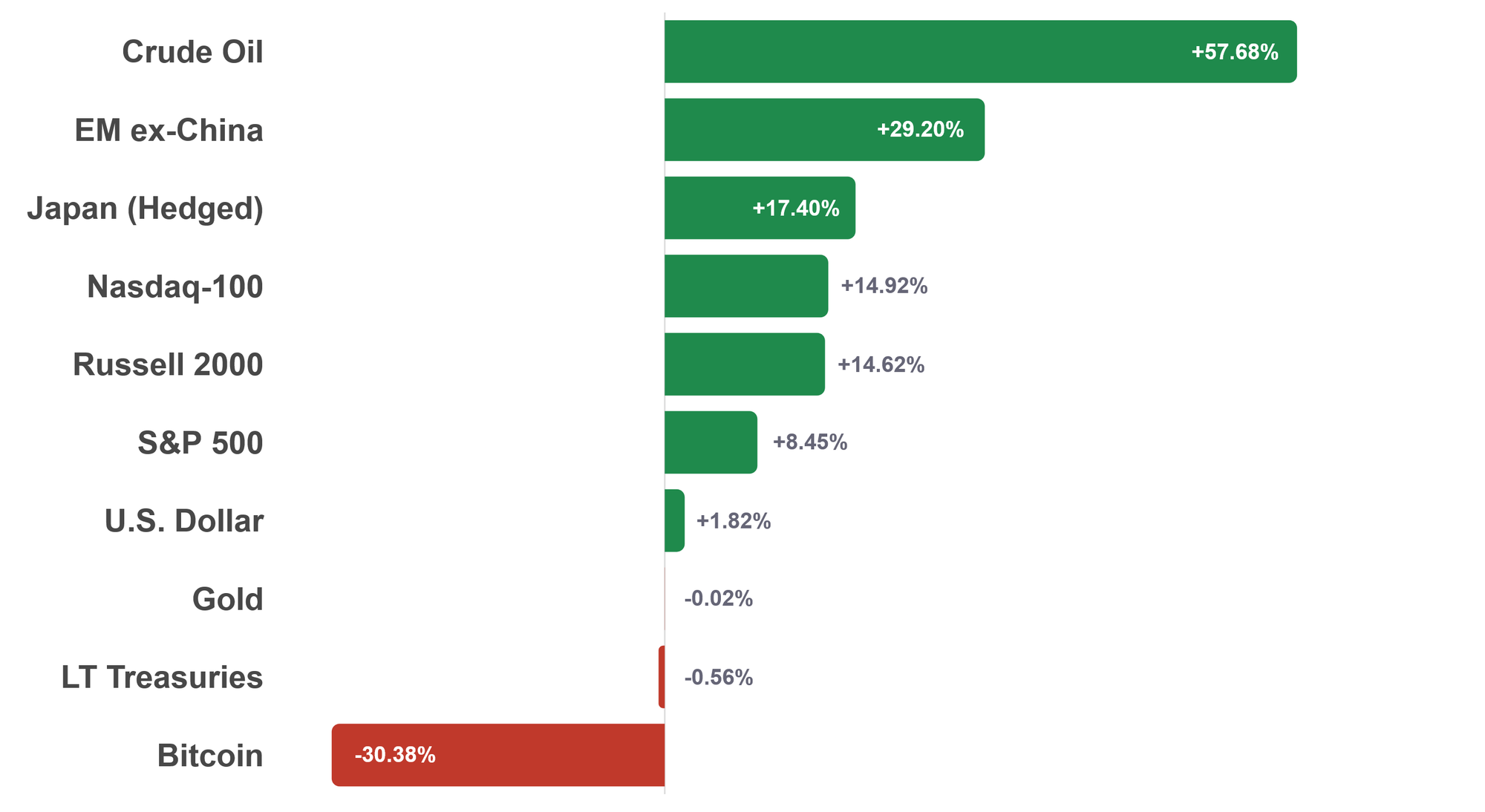
Crude oil still leads the year at +57.68%, though that lead has narrowed sharply from +87.69% a few weeks ago as ceasefire optimism pulled energy prices down. Emerging markets ex-China is next at +29.20%, followed by hedged Japanese equity (+17.40%), the Nasdaq-100 (+14.92%), and the Russell 2000 (+14.62%). The S&P 500 sits at +8.45% and the dollar is up 1.82%. Gold is roughly flat at -0.02% after its long run stalled, and long Treasuries are down 0.56%. Bitcoin is the clear laggard at -30.38%.
Inflation, Jobs, and the Fed
April CPI rose to 3.8% year-over-year, a three-year high and up from 3.3% in March, with energy still a major factor from the spring's oil shock.
Then came the May payrolls report on Friday. The economy added 172,000 jobs against expectations closer to 80,000, with unemployment holding at 4.3%. On most Fridays that would read as good news. With inflation already running hot, a labor market this strong does the opposite. It raises the odds that the Fed hikes rather than cuts, and that is what sent stocks lower.
Kevin Warsh took over as Fed chair in late May and will run his first policy meeting in mid-June. Markets now put the odds of a 2026 rate hike at roughly one in three, a possibility that was barely on the table a few months ago. None of this changes what the strategy holds. The rankings decide that. But it explains why a portfolio tilted toward rate-sensitive small caps and emerging markets had a rough Friday.

Portfolio Allocations for June
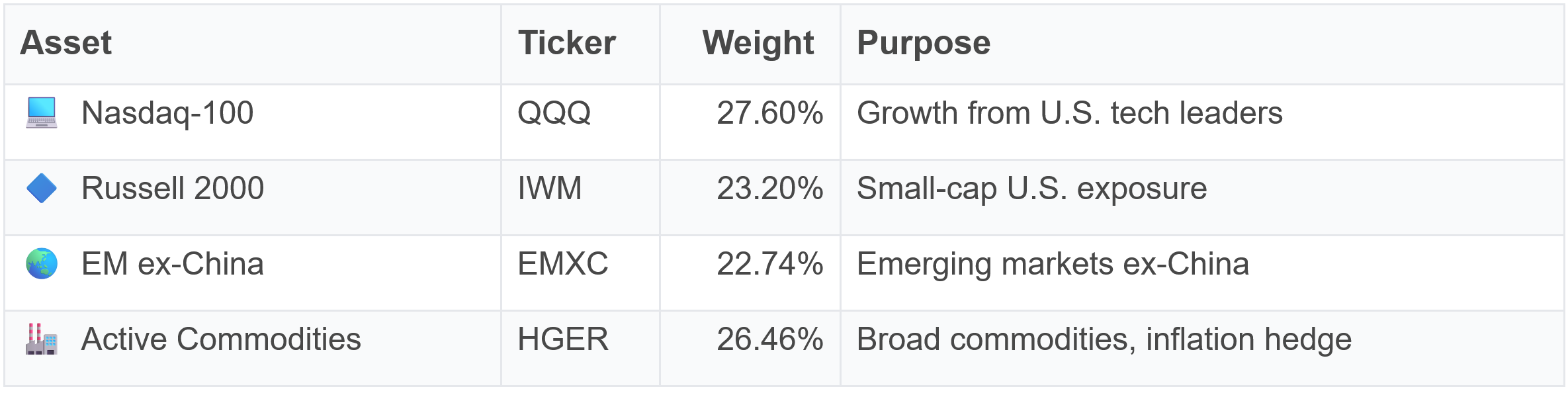
The same four ETFs that ranked highest in May ranked highest again, so the strategy held them. The Nasdaq-100 and active commodities anchor the allocations, with the Russell 2000 and emerging markets ex-China rounding out the four. If I were picking based on Friday's headlines, three-quarters of the portfolio in equities heading into a rate scare would feel reckless. But the strategy follows the rankings, not the news, and decades of backtesting show those rules cushioning the worst sustained drawdowns better than the S&P 500 or a traditional balanced portfolio in most cases.
Deep Dive: Six Selloffs, One System

The premise
Friday was the strategy's worst single day in months. The portfolio dropped roughly 4.5%, nearly double the decline in the S&P 500 and the 80/20 benchmark.
The reason is straightforward: Right now about 73% of the portfolio sits in equities (the Nasdaq-100, the Russell 2000, and emerging markets ex-China) with the rest in active commodities. The portfolio currently has no defensive allocations. Gold, defensive equity, long term Treasuries, and short-term Treasuries are all outside the top four.
When the market sells off broadly on a day like Friday, a portfolio with that much equity exposure is going to fall harder than a balanced benchmark. That is not a flaw. It is what a momentum strategy looks like when the trend is still pointing up.
The question readers are asking is the obvious one: If Friday is the start of something bigger, will the strategy ride it all the way down?
I went back to the backtest and pulled the major S&P 500 selloffs since June 1995 that the strategy entered fully risk-on, the same way it is positioned today at roughly 62% to 74% equities. Six episodes fit, ranging from the dot-com bust to the 2022 bear market.
The strategy has only traded live since January 2024, so these six runs are reconstructed from the backtest, not the live record, which has not yet faced a major bear market. Even so, the backtest uses the strategy's exact rules, with every parameter identical, from the momentum lookbacks and ranking rules to the monthly rotation and risk-parity weighting.
Here is what happened, two episodes at a time.
Defensive before the peak
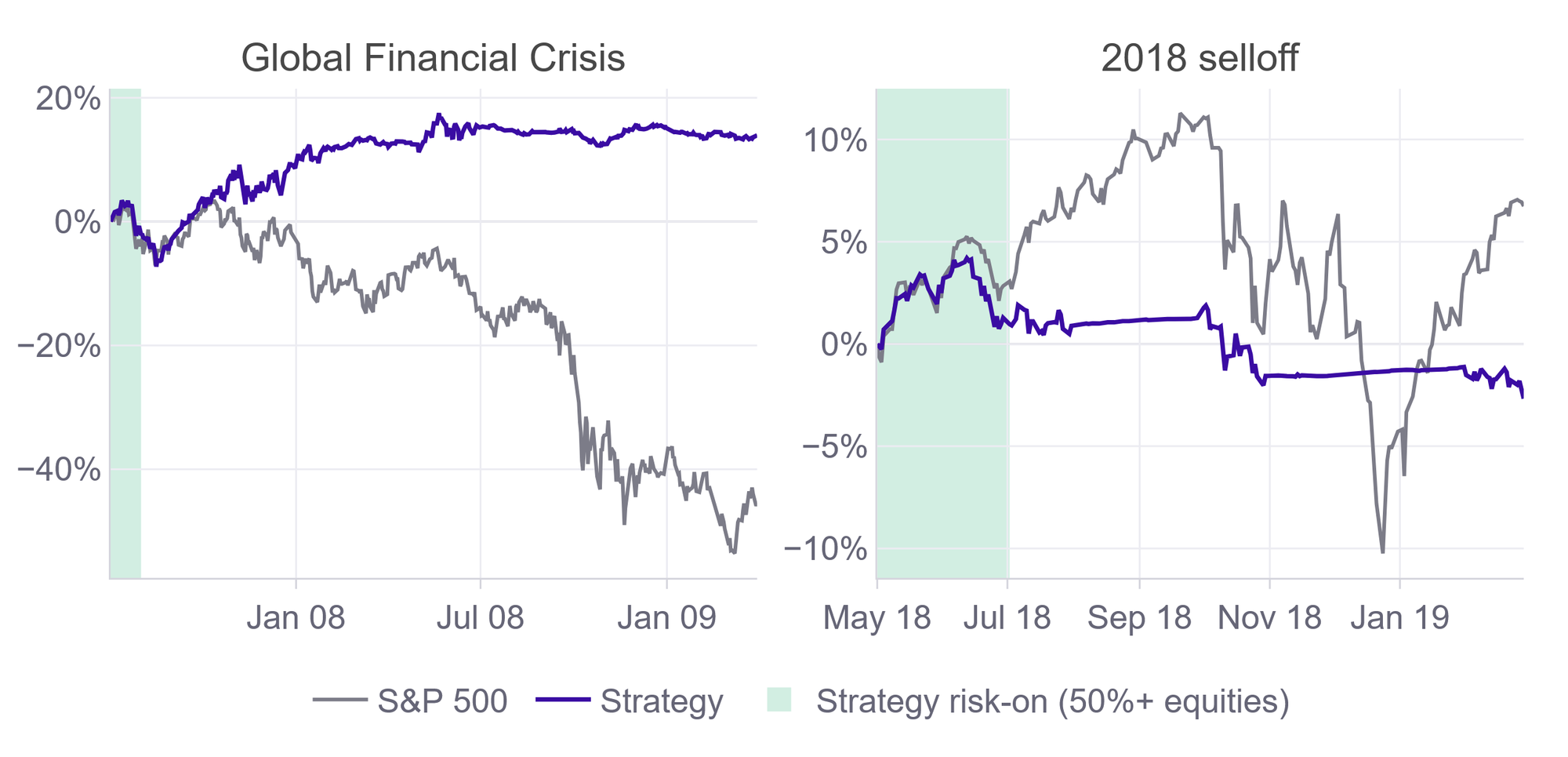
In both the Global Financial Crisis and the 2018 selloff, the strategy had already rotated to defensive positioning before the equity market peaked. The monthly momentum signal detected weakening strength in equities ahead of the headline drop. The GFC is the more dramatic case. The strategy returned about +15% over the window while the S&P 500 fell 55%. In 2018, the strategy lost about 4% against a 19% decline in the index.
The pattern in recent memory
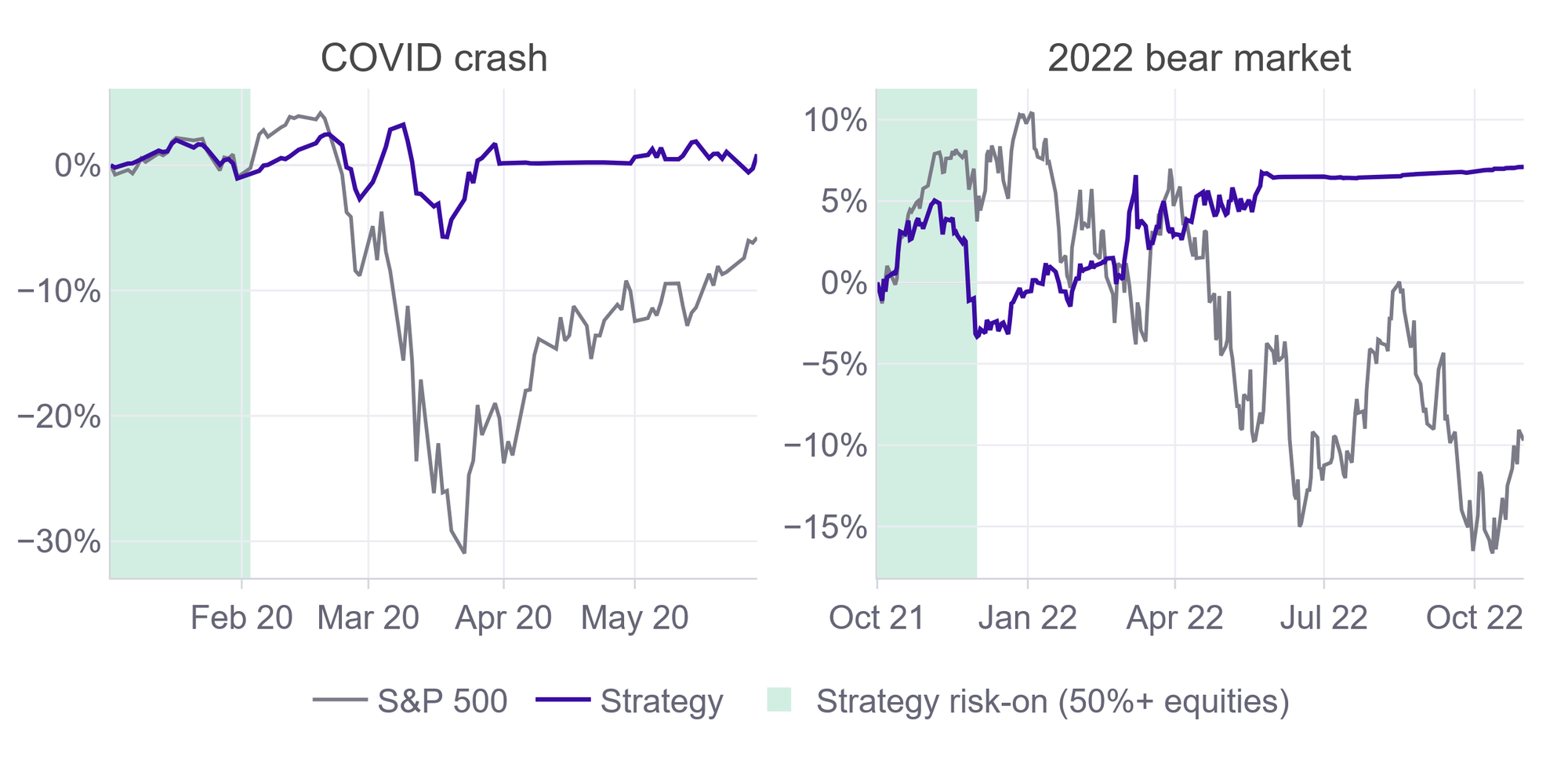
COVID was fast and violent, a 34% drawdown in five weeks. The 2022 bear was slow and grinding, stretching across nearly ten months. In both, the strategy preserved capital rather than riding the decline down. In each case, momentum had already weakened enough to flip the portfolio to defensive before the worst of the decline. The strategy gained about 1% during COVID and about 3% during the 2022 bear while the S&P fell double digits in both.
The imperfect exits
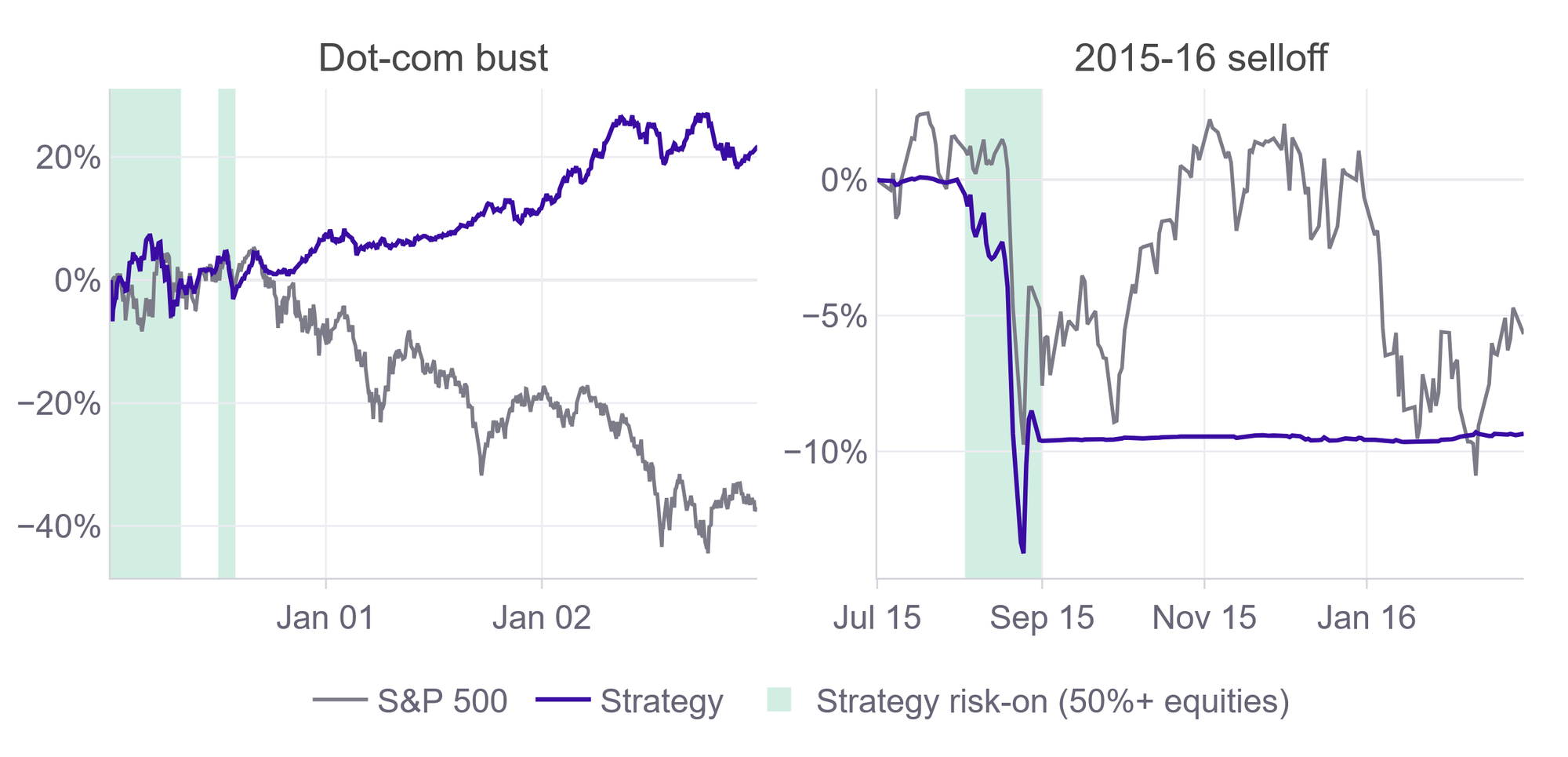
These two are the episodes where the strategy was still fully risk-on at the peak and rode part of the decline before the signal cut exposure. The outcomes were very different. In the dot-com bust, the strategy gained about 22% over the full window while the S&P fell 47%, because once the rotation to defensive kicked in, the alternative assets (led by anti-beta) carried the portfolio for two and a half years. In the 2015-16 selloff, the strategy lost money, and lost more than the S&P itself.
A note on methodology: The S&P 500 is proxied by SPY, and the strategy path is reconstructed from daily data. The full method, including why these figures differ from the May issue, and the backfill chains are in the Methodology and Backfill Notes at the end of this issue.
The worst case on the board
I want to be direct about 2015-16 because it is the episode that shows the real cost of following trends, getting whipsawed when the market chops sideways instead of trending.
The strategy went risk-on in May 2015 at about 72% equities, right near the peak. By July, momentum had weakened and the signal flipped the portfolio to 95% short-term Treasuries. That was good timing.
But the signal reversed again in August, pushing the portfolio back to 92% equities, the most aggressive allocation in the data set. China's currency devaluation and the August flash crash hit immediately. The portfolio lost 9.58% in a single month.
By September, the signal cut back to cash, but the equity market was near its lows. The strategy exited at roughly the worst price of the selloff and missed the recovery that followed.
The cumulative damage over the episode was -11.75%, which exceeded the S&P 500's own decline over the same window. This is the only one of these six episodes where the strategy underperformed the market. It is real, it was painful in the backtest, and I include it because a system that only shows its wins is not a system worth trusting.
The rotation in action
When the strategy did get out in time, what did it rotate into? The answer changed with every crisis.
Anti-beta carried the dot-com bust, contributing roughly 6.4 percentage points to the portfolio's return during the defensive months. Gold led the GFC at about 9.3 percentage points. Long Treasuries surged during COVID, adding 3.9 percentage points. Active commodities powered through 2022 at about 8.0 percentage points. And in the one stretch that overlaps with the live account so far, the 2025 tariff selloff, gold again led the way at 3.2 percentage points.
The common thread was not any single alternative. It was short-term Treasuries. In every episode, once the strategy went fully defensive, risk-parity weighting pushed that cash position to between 83% and 97% of the portfolio. Short-term Treasuries are not there to grow the portfolio. They keep capital out of harm's way while stocks fall. That is the engine that turns a rotation signal into portfolio-level protection.
In the live account, this is exactly what happened in early 2025. The strategy went from 70% equities in January to 40% in February to zero in March, with 95% in short-term Treasuries by April. Capital was preserved while equities fell. The signal worked in real time, not just in a spreadsheet.
The trade-off
The strategy does not call tops. It does not avoid the first leg of a sharp decline. It can whipsaw, and 2015-16 proves it. Today the portfolio sits at approximately 73% equities, the same exposed state every one of these episodes began in. If Friday turns out to be the start of a sustained turn, the realistic expectation is that the strategy rides part of the decline before the monthly signal cuts exposure, not that it exits at the peak.
That is a real cost. In five of these six selloffs, the backtest shows the trade-off paying off, with the strategy either outperforming significantly or preserving capital while equities fell double digits or more. In the one where it did not, the loss was bounded and the system corrected within a month.
After a day like Friday, the hardest thing is doing nothing. But the monthly cadence is a pre-commitment device. I wrote the rules in advance so I would not have to make decisions under stress. The four defensive ETFs are still in the basket, still being ranked every month. If one climbs into the top four, the strategy will rotate. That is the system.
Quote of the Month
Far more money has been lost by investors preparing for corrections, or trying to anticipate corrections, than has been lost in corrections themselves. - Peter Lynch
That is the trap Friday set. The instinct after a 4.5% day is to do something, to brace for the next leg. The strategy's answer is to hold what the rankings say to hold and let the monthly signal, not the fear, decide when to move.
Wrap Up

Seeing a 4.5% down day and reading news reports about "AI bubbles" is unnerving, which is exactly why I follow a systematized, rules-based approach that takes the emotion out of my investment decisions. If a defensive ETF climbs back into the top four, the strategy will become more defensively positioned. Until then it holds what is working and trusts the tape over the headlines. Thanks for reading, and if you have questions or feedback, I would love to hear it.

Methodology and Backfill Notes
The deep-dive charts in this issue are a reconstruction, not a live track record. The strategy went live on January 2, 2024, so every selloff before that date is rebuilt by running the strategy's actual monthly ranking rules over historical data and holding the positions those rules would have selected. The equity percentages, the risk-on and defensive states, and the returns shown for those windows all come from that reconstruction. The one episode that overlaps the live account is the 2025 tariff selloff.
Why these figures differ from the May issue. The May deep dive used a simplified version of the strategy and reported the maximum peak-to-trough decline within each crisis window on monthly total-return data. This issue uses the strategy's actual momentum inputs on daily total-return data and measures the full-window return indexed to each window's start. Different inputs and a different measurement window produce different numbers for the same episodes, which is why the dot-com figure here (about +22%) is not the same as the roughly +31% shown in May. Going forward I intend to reconstruct these windows with the live strategy's real settings, since that is the more faithful test.
How the history is extended. Most of the ETFs the strategy trades did not exist in 1995, so each one's price history is extended backward with an older fund or index that tracks the same or similar exposure. The table below lists each chain and roughly when the live ETF takes over.
| Asset | Live ETF | Backfilled with, until the live ETF begins |
|---|---|---|
| Active commodities | HGER | A synthetic commodity index, then the QCI commodity index, through early 2022 |
| Defensive equity (anti-beta) | BTAL | The AQR Betting-Against-Beta factor series, through September 2011 |
| Short-term Treasuries | BIL | The VFISX short-Treasury fund, through May 2007 |
| Long Treasuries | TLT | The VUSTX long-Treasury fund, through July 2002 |
| Gold | GLD | Spot gold prices, through November 2004 |
| Nasdaq-100 | QQQ | The FSPTX technology fund, through March 1999 |
| Russell 2000 | IWM | The OTCFX small-cap fund, through May 2000 |
| EM ex-China | EMXC | The VEIEX, then EEM, emerging-market funds, through July 2017 |
| Japan hedged equity | DXJ | The FJPNX Japan fund, through June 2006 |
| 60/40 benchmark | AOR | The VSMGX balanced fund, through November 2008 |
| 80/20 benchmark | AOA | The VASGX balanced fund, through November 2008 |
Backtested and backfilled results are hypothetical. They do not reflect actual trading, they were built with the benefit of hindsight, and they carry the inherent limitations of any simulation. Past performance does not guarantee future results.
Disclaimer & Disclosure
This newsletter is for informational purposes only and does not constitute financial advice, investment recommendations, or an offer to sell or buy any securities. The content is published as a journal of the author's personal investment activities and is intended for a general audience.
No Investment Advice: The author is not a financial advisor. You should not treat any opinion expressed herein as a specific inducement to make a particular investment or follow a particular strategy, but only as an expression of opinion.
Risk Warning: Investment involves risk, including the possible loss of principal. Past performance is not indicative of future results. No investment strategy or risk management technique can guarantee returns or eliminate risk in any market environment.
Data & Accuracy: Information contained herein has been obtained from sources believed to be reliable, but its accuracy and completeness are not guaranteed. All expressions of opinion are subject to change without notice in reaction to shifting market conditions.
Positions: The author currently holds positions in the securities mentioned in this newsletter. The author may buy or sell these securities at any time without notice.
Copyright: This content is provided solely for the personal use of the subscriber. Any unauthorized copying, forwarding, or distribution of this material is prohibited without prior written consent.