Trusting the Tape Over the Headlines
After three months out of U.S. stocks, QQQ and IWM are back in the lineup for May. Gold is dropping out. Here's the new portfolio and why it shifted.


My May portfolio allocations are below. After three months of zero direct U.S. equity exposure, two U.S. stock ETFs (the Nasdaq-100 and Russell 2000) are back in the lineup, and gold is dropping out. Here's what changed and why.
Portfolio Allocations for May
| Asset | Ticker | Weight | Purpose |
|---|---|---|---|
| 💻 Nasdaq-100 | QQQ | 27.60% | Growth from U.S. tech leaders |
| 🛢️ Active Commodities | HGER | 26.46% | Broad commodity exposure with inflation sensitivity |
| 🔷 Russell 2000 | IWM | 23.20% | Small-cap U.S. exposure |
| 🌏 EM ex-China | EMXC | 22.74% | Emerging markets diversification without China risk |
For reference, April's lineup was active commodities 29.85% / emerging markets ex-China 26.72% / Japan hedged equity 23.84% / gold 19.59%.
What Changed
- 🆕 The Nasdaq-100 enters at 27.60% and the Russell 2000 enters at 23.20%, restoring U.S. equity exposure for the first time since January
- 📤 Japan hedged equity exits after two months in the lineup, losing the equity-basket ranking
- 📤 Gold exits after holding a top-four spot for most of 2025 and into 2026, with momentum flat to negative for several months
- ⚖️ Active commodities and emerging markets ex-China trimmed to make room for the new positions
📌 This newsletter explains how I invest my own money, using a simple portfolio of four ETFs. I share what I hold and why, so readers can see one real world approach in action.
April MTD: Asymmetric Edge +4.7% vs. S&P 500 +9.4%
YTD through 4/29: Asymmetric Edge +15.9% vs. S&P 500 +4.6%
YTD outperformance margin: +11.3 percentage points
Why the Portfolio Shifted
If you kept up with the news in April, I doubt you'd have guessed the S&P 500 would be setting fresh records. War, oil above $100, a stalled Fed, and a hawkish dissent at the FOMC are the headlines. But prices climbed anyway, and the rankings now point to adding U.S. stocks back into the portfolio.
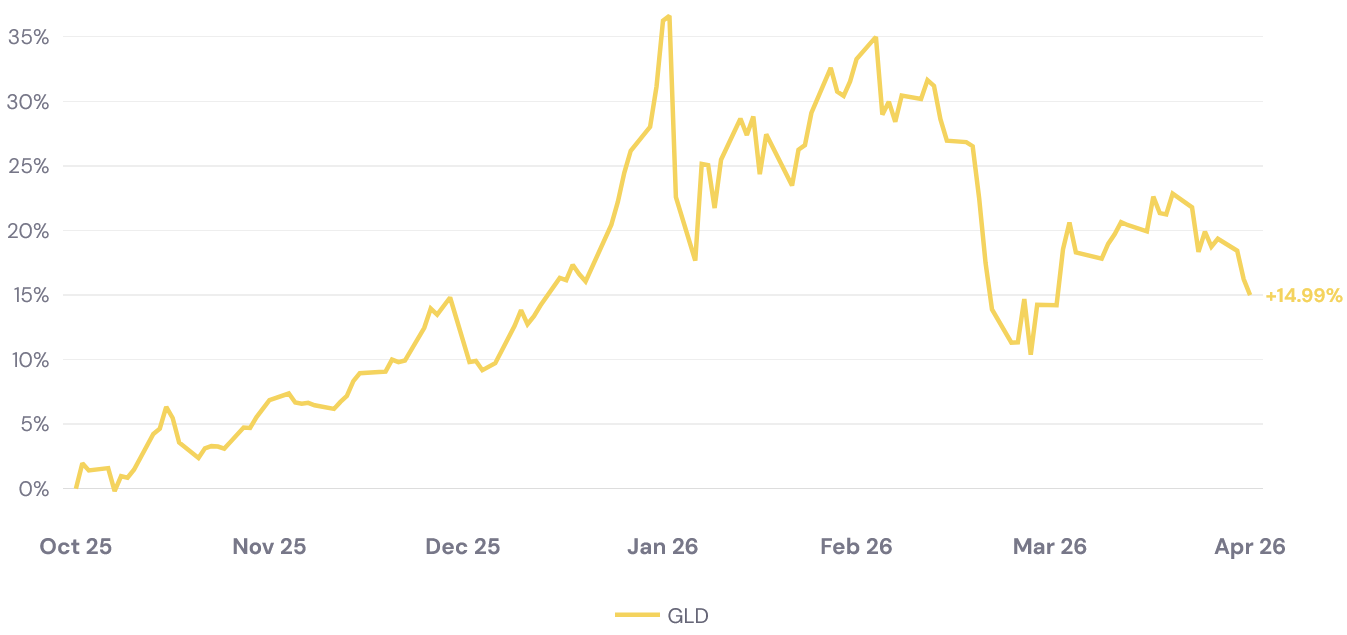
Gold's exit is the bigger surprise. After a historic run that peaked near $5,600 in late January, the price chopped sideways for about three months. Active commodities (HGER), which includes a variety of commodity futures contracts including oil, moved ahead of gold in the momentum rankings. HGER and emerging markets ex-China (EMXC) stay in but received smaller allocations than last month. The portfolio went from zero direct U.S. equity in April to about 51% U.S. stocks heading into May. This is how the strategy works: when an asset class picks up steady momentum and begins to outpace other options, it receives a portfolio allocation.
Just Outside the Top Four
Two notable assets just dropped out, and both are worth a quick look.
Japan hedged equity lost the equity-basket ranking. The strategy looks at four equity ETFs (emerging markets ex-China, Russell 2000, Nasdaq-100, and Japan hedged equity) and ranks them on recent momentum, dropping the lowest. Japan's run flattened in March and April, and it came in last place this month.
Gold is the bigger story. After peaking near $5,600 in late January, the metal has chopped sideways and drifted lower for three months running. Active commodities outscored it on momentum and took the alts/commodity slot.
Quick Take
Stocks rallied. The portfolio held. The strategy still leads in 2026. The S&P 500 gained 9.4% on the month while the Asymmetric Edge strategy added 4.7%. The 80/20 portfolio outpaced us at 6.0%, and we tied a 60/40 portfolio at 4.7%. With the portfolio sitting in commodities, gold, EM, and Japan all month while U.S. stocks ripped, that result is in line with what I would expect from a balanced portfolio. We were never going to keep up with a U.S.-stock-heavy benchmark from a portfolio with no U.S. stocks in it.
Zoom out and the picture changes. A hypothetical $10,000 invested at the start of the year would now be worth $11,587 in the strategy versus $10,463 in the S&P 500, $10,472 in an 80/20 portfolio, and $10,360 in a 60/40 portfolio. The strategy has roughly tripled the S&P's YTD return.
Charting the Growth of $10,000
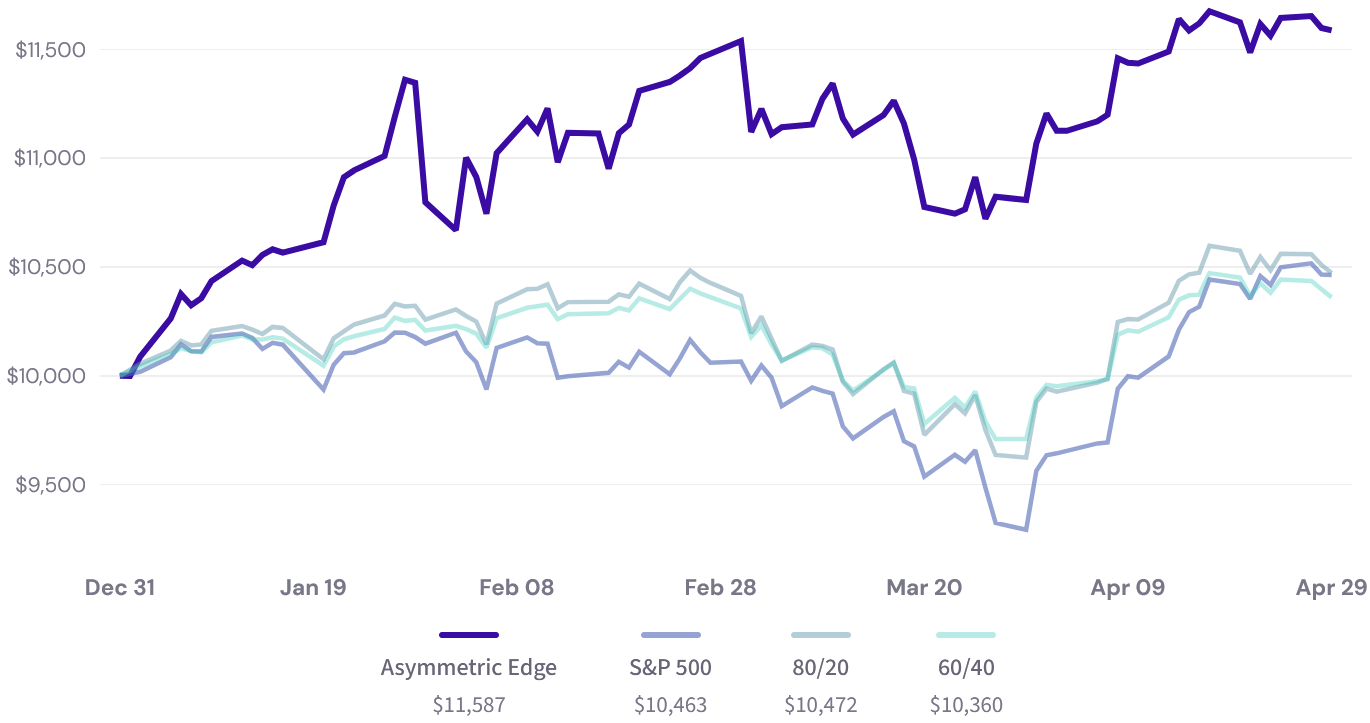
The YTD shows the outperformance clearly. The strategy gained a big lead through January and February, gave some back during the late-March selloff, and held those gains through April even as the benchmarks closed some of the gap.
Brief Market Commentary
U.S. equities ripped to record highs. The S&P 500 closed around 7,173 on April 27, a record, and the Nasdaq hit 24,887. President Trump extended the Iran ceasefire on April 8, removing the worst-case geopolitical scenarios. Q1 earnings came in strong, with more than 80% of S&P 500 reporting companies beating estimates. And the AI trade reaccelerated, with Nvidia pushing past a $5 trillion market cap.
Iran and oil, no closer to resolution. The Strait of Hormuz remains effectively closed. The U.S. blockade of Iranian ports began April 13, creating a "dual blockade." Trump rejected Iran's latest proposal late in the month, and peace talks stalled. WTI crude pushed back above $100 per barrel, and gasoline crossed $4 per gallon.
Gold pulled back. Fed held. Powell's last meeting. Gold slipped to roughly $4,580 by April 29, about 18% below its January high, as the dollar firmed and Treasury yields ran near 4.4%. The April 29 FOMC meeting (likely Powell's last as chair) held rates at 3.50% to 3.75%. Kevin Warsh advanced through the Senate Banking Committee the same morning and is on track to take over.
What I'm Watching
The most striking thing about May's portfolio is how little it has to do with the news. Roughly 51% sits in U.S. stocks (the Nasdaq-100 and Russell 2000), with another 22.74% in emerging markets. That's about three-quarters of the portfolio in equities, at a moment when an active war is cutting off a fifth of the world's seaborne oil. If I were picking based on headlines, this allocation would feel reckless. But the strategy follows a well-tested, systematized method for making investment decisions, not headlines. U.S. stocks are at records because earnings are strong, the worst tail risks of the Iran conflict have been priced out, and capital keeps flowing into AI infrastructure.
The biggest risks for May seem to be another Iran-related oil spike that could push inflation higher, a hawkish surprise from the Powell-to-Warsh transition, or a sharp pullback after such a fast rally (the S&P's CAPE ratio is near 40, levels last seen in 1999). If any of those flips the momentum picture, the strategy will rotate. That is the value of trusting the tape. It tells you when conditions change long before the headlines confirm it.
Up Next
The full May newsletter is coming next week or two with detailed performance data, risk metrics, and this month's deep dive. Thanks for reading.

Disclaimer & Disclosure
This newsletter is for informational purposes only and does not constitute financial advice, investment recommendations, or an offer to sell or buy any securities. The content is published as a journal of the author's personal investment activities and is intended for a general audience.
No Investment Advice: The author is not a financial advisor. You should not treat any opinion expressed herein as a specific inducement to make a particular investment or follow a particular strategy, but only as an expression of opinion.
Risk Warning: Investment involves risk, including the possible loss of principal. Past performance is not indicative of future results. No investment strategy or risk management technique can guarantee returns or eliminate risk in any market environment.
Data & Accuracy: Information contained herein has been obtained from sources believed to be reliable, but its accuracy and completeness are not guaranteed. All expressions of opinion are subject to change without notice in reaction to shifting market conditions.
Positions: The author currently holds positions in the securities mentioned in this newsletter. The author may buy or sell these securities at any time without notice.
Copyright: This content is provided solely for the personal use of the subscriber. Any unauthorized copying, forwarding, or distribution of this material is prohibited without prior written consent.