
My Asymmetric Edge strategy still leads every benchmark year to date at 13.81%, ahead of 9.36% for the S&P 500, 7.10% for an 80/20 portfolio, and 5.06% for a 60/40 portfolio, even after a 12.54% decline from its October 6th high, its first correction (a decline of 10% or more from a high) since going live.
This issue covers why chip stocks, oil, and Bitcoin got hit hard and why small caps held up better. None of my asset allocations have changed since the October 30th rebalance. The deep dive covers why the pull for certainty is so strong, and how I've learned to act in the face of uncertainty.
📌 This newsletter documents how I invest my own money with a simple, rules-based strategy. The aim is to match or exceed the returns of a traditional balanced portfolio, but with shallower drawdowns. I share what I hold and why so you can watch it play out.
What Moved
- 💻 Chip and data-center stocks sold off. The Nasdaq-100 fell 6.36% on November 5th, its worst day since 2020, on artificial intelligence (AI) regulation fears after the Democrats' midterm sweep. The next Monday, Morgan Stanley and UBS called it overdone and said extreme regulation of data centers was unlikely.
- 🛢️ Oil prices reversed sharply this month. Brent crude, the international oil benchmark, fell 16% in the week ending November 6th, its steepest weekly decline since the Covid-19 pandemic began. On November 10th, Brent fell below $90 a barrel for the first time since August after President Trump played down Iran strikes.
- 🟠 Bitcoin extended its slide through November. It broke below $76,000 on November 5th as more than $1 billion of leveraged bets were forced to close in a day. It kept falling after that, and my Bitcoin fund is down 15.15% in November and 33.64% below its January 14th high.
- 🔷 Small caps held up better. Small caps (the Russell 2000) are down 2.29% in November, against a 4.16% decline for the Nasdaq-100. That leaves small caps up 11.63% this year, ahead of 9.36% for the S&P 500 and 8.09% for the Nasdaq-100.
🎢 Theme of the Month: Momentum Crash
A momentum crash happens when the investments that had been rising fastest suddenly reverse and fall together. This month it hit chip stocks and broad commodities. Broad commodities is still the top performer of my ten funds year to date, up 32.35%, but it took the most off my return in November. Because a momentum strategy owns what has been rising, a reversal like this can hurt it more than a balanced portfolio.
🛢️ One Number That Matters: 16%
That's how much Brent crude fell in the week ending November 6th, according to Reuters, its steepest weekly decline since the Covid-19 pandemic. Oil's reversal is the main reason my broad commodities fund is down 7.67% in November.
Market Moves
Portfolio and Benchmark Returns
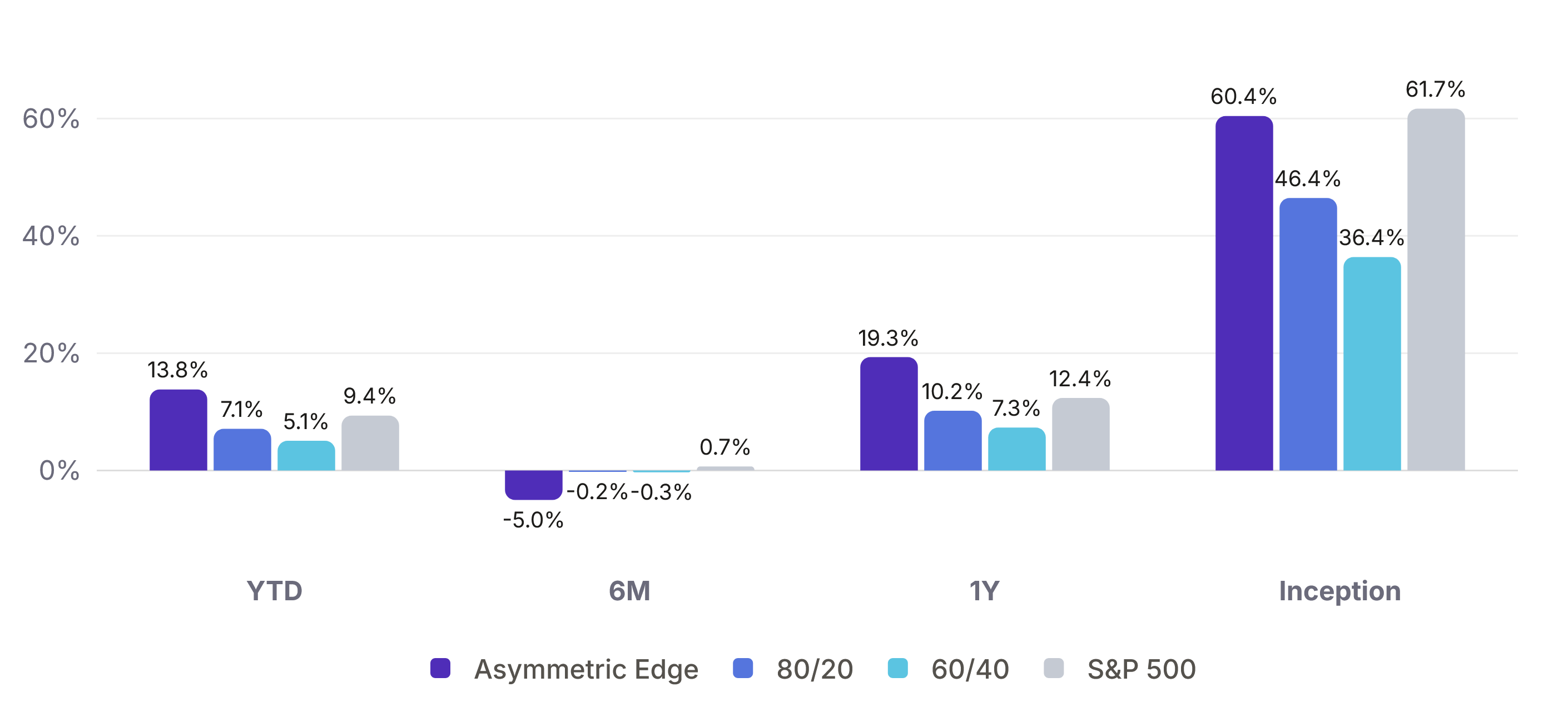
My strategy is down 5.98% in November, against losses of 1.58% for the 80/20 (my main benchmark, a mix of 80% stocks and 20% bonds), 1.47% for the 60/40, and 2.09% for the S&P 500. On Monday it fell 2.57% and closed 12.54% below its October 6th high, a correction. Since October 6th, the 80/20 is down 3.76% and the S&P 500 is down 5.02%.
Over six months, the strategy trails all three benchmarks, down 5.0% against losses of 0.2% for the 80/20 and 0.3% for the 60/40, while the S&P 500 is up 0.7%.
Since going live on January 2nd, 2024, it's now slightly behind the S&P 500 (60.41% vs. 61.68%). It stays well ahead of the 80/20 at 46.44% and the 60/40 at 36.38%. Over one year, it leads all three at 19.3%, ahead of 12.4% for the S&P 500, 10.2% for the 80/20, and 7.3% for the 60/40.
Year-to-Date Growth of $10,000
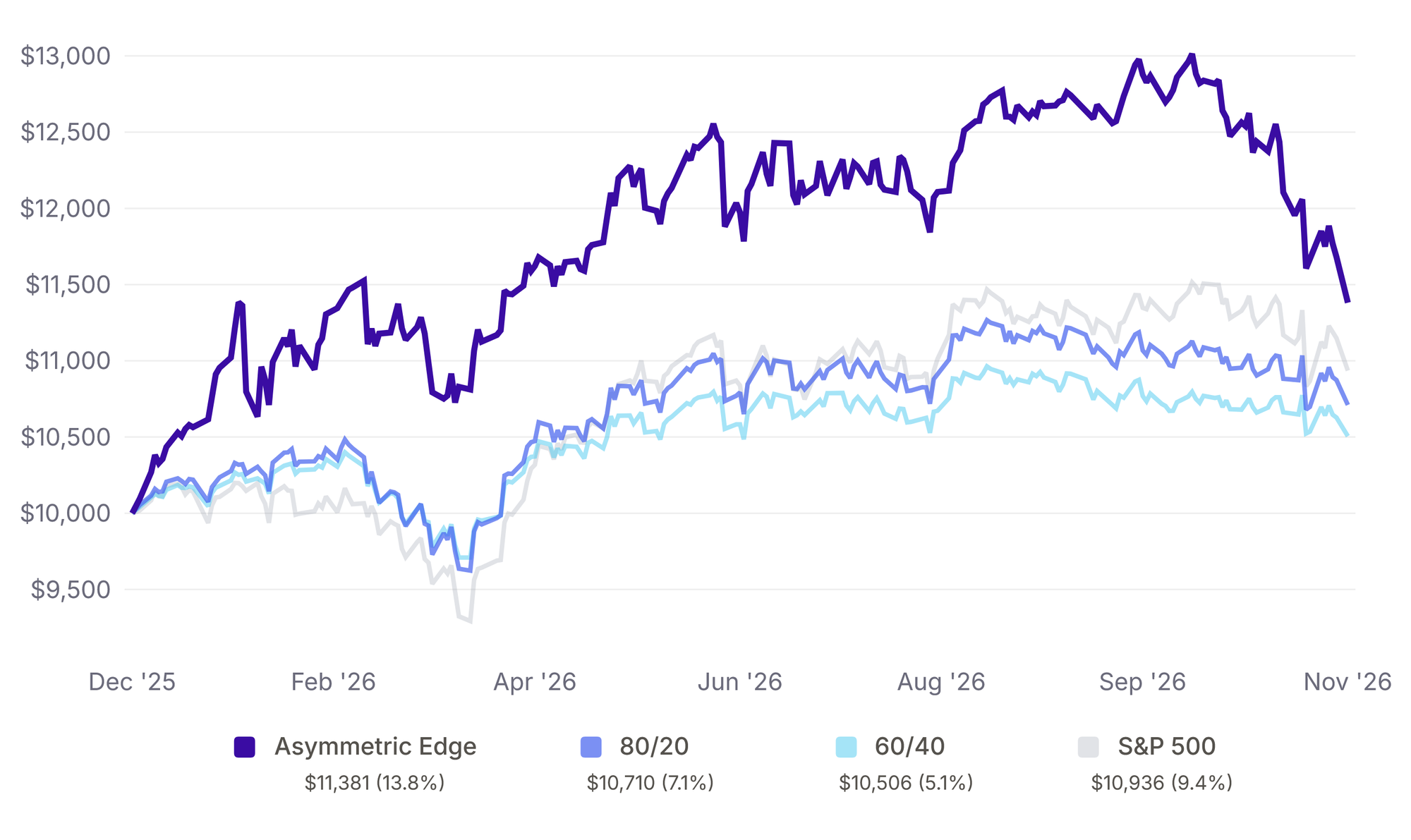
Ten thousand dollars invested on December 31st, 2025 would now be worth about $11,381 in my strategy, against $10,936 in the S&P 500 and $10,710 in the 80/20. The decline since October 6th has trimmed this year's lead. If you started following recently, you've seen this drawdown without the rally before it.
Year-to-Date Asset Class Returns
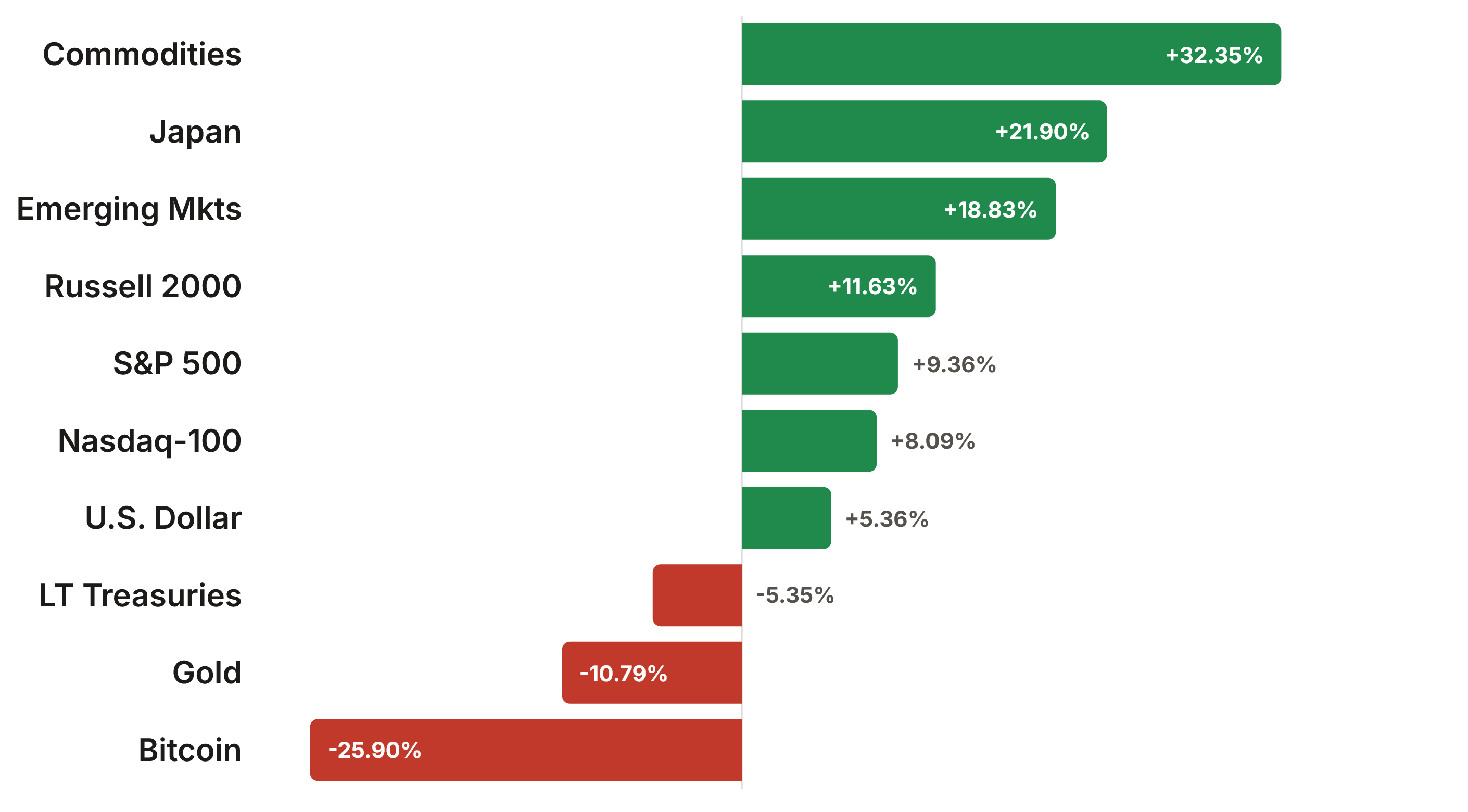
Even after November, broad commodities leads every fund on this chart at 32.35% year to date. Japan is next at 21.90%, followed by emerging markets at 18.83%. Bitcoin is last, down 25.90% for the year.
The defensive funds are mostly down this year. Gold, long-term Treasuries, and defensive equity are all in the red.
Since October 6th, though, defensive equity (ticker BTAL) is up 14.02%. It buys low-beta stocks, which tend to move less than the overall market, and bets against high-beta stocks, which tend to move more. That approach tends to work best in selloffs, when high-beta stocks usually fall the most.
Oil's Reversal and Broad Commodities
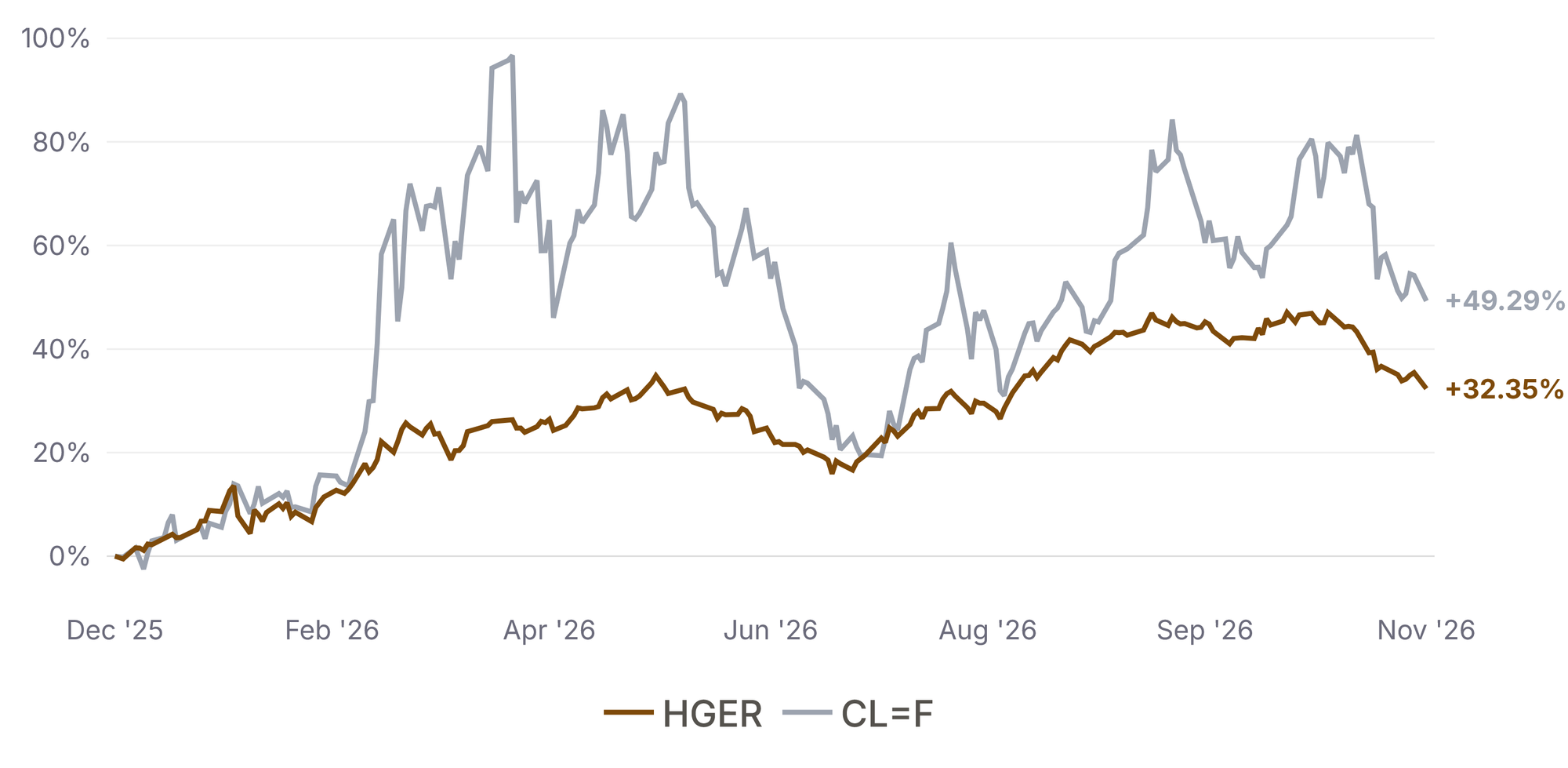
Brent crude fell 16% in the week ending November 6th and kept falling after that. Prices slid after President Trump played down new strikes on Iran, and Persian Gulf crude exports have been recovering toward levels from before the Iran war. On November 10th, Brent fell below $90 a barrel for the first time since August.
U.S. crude oil futures are down about 18% in November, though they're still up 49.29% for the year. Oil's reversal pulled broad commodities down 7.67% this month and left it 10.00% below its October 13th high. The fund fell less than oil because it tracks an index of many commodities, and oil is one part of it.
On November 5th, oil and fuels were about 12% of my whole portfolio, alongside gold, crops, livestock, and industrial metals inside the same fund. The index's weights shift over time.
What My Broad Commodities Fund (HGER) Holds
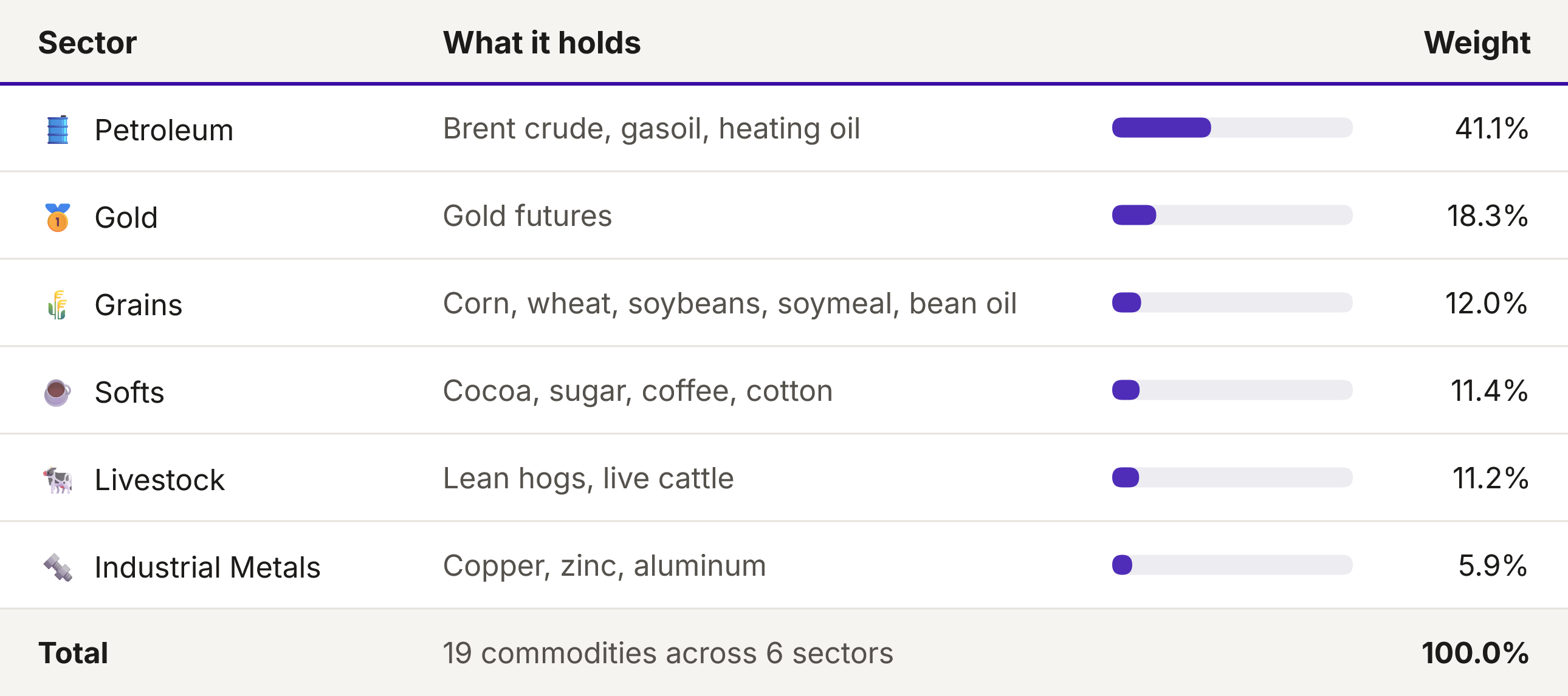
Broad commodities remains my second-largest position behind small caps, and nothing changes until my November 30th rebalance.
Portfolio Allocations
How My Four Positions Have Drifted This Month
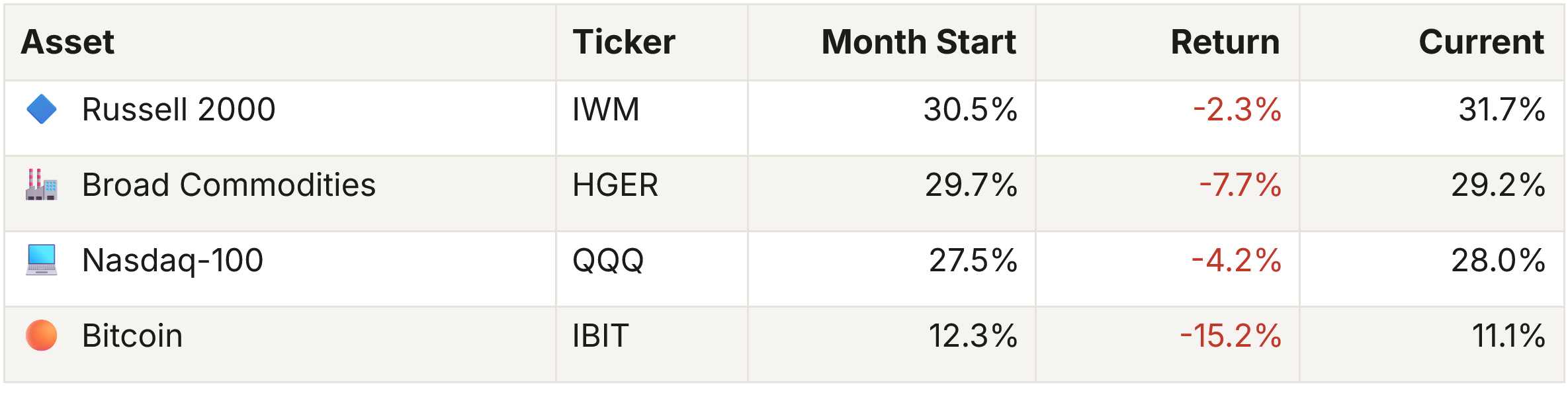
All four of my funds are down in November. Broad commodities took the most off the portfolio's return this month: about 2.28%, followed by 1.86% from Bitcoin, 1.14% from the Nasdaq-100, and 0.70% from small caps.
Bitcoin is my smallest position because it's the most volatile of the four, yet its 15.15% loss still made it my second-largest drag. At the October 30th rebalance, small caps replaced emerging markets and held up better. They're down 2.29% since then, against a 4.28% decline for emerging markets.
Holding stocks, commodities, and Bitcoin through a selloff feels uncomfortable, but I own them because they had the strongest momentum at the last rebalance. The defensive funds I track are gold, T-bills, long-term Treasuries, and defensive equity. If the defensive funds have stronger momentum than my stock funds, commodities, and Bitcoin at the November 30th rebalance, they could take their place.
Deep Dive: Stop Trying to Predict the Future
With my strategy in its largest decline since going live, one question keeps pulling at me (and maybe at you): how much worse will this get? I've caught myself checking my account and market news more often than usual. Part of me is grasping for certainty in an inherently uncertain situation. As a therapist, I recognize the pattern well.
Why not knowing is so uncomfortable
Some people treat the chance of a bad outcome as unacceptable, even when it's unlikely. Researchers call that intolerance of uncertainty, and it's a well-studied factor that keeps worry and anxiety going.
In a 2016 University College London study, volunteers played a computer game in which they sometimes got a painful electric shock, and the odds of a shock kept changing as they played. Their stress was highest when the odds were about 50/50. A coin-flip chance of a shock was more stressful than knowing—for sure—that a shock was coming.
Investors tend to handle drawdowns in one of two ways. Some look away, and others can't stop watching. A study of 100,000 Vanguard retirement accounts in 2007 and 2008 found people logged in less often after ordinary declines, a head-in-the-sand response researchers call the ostrich effect. Other researchers found investors checking their portfolios more after both gains and losses (the meerkat effect).
This month I've been a meerkat.

What my backtest can and can't tell me
Before my November 6th special update, I stress-tested my strategy. I varied its settings and scrutinized the results for possible problems. That was due diligence, to make sure I hadn't missed anything.
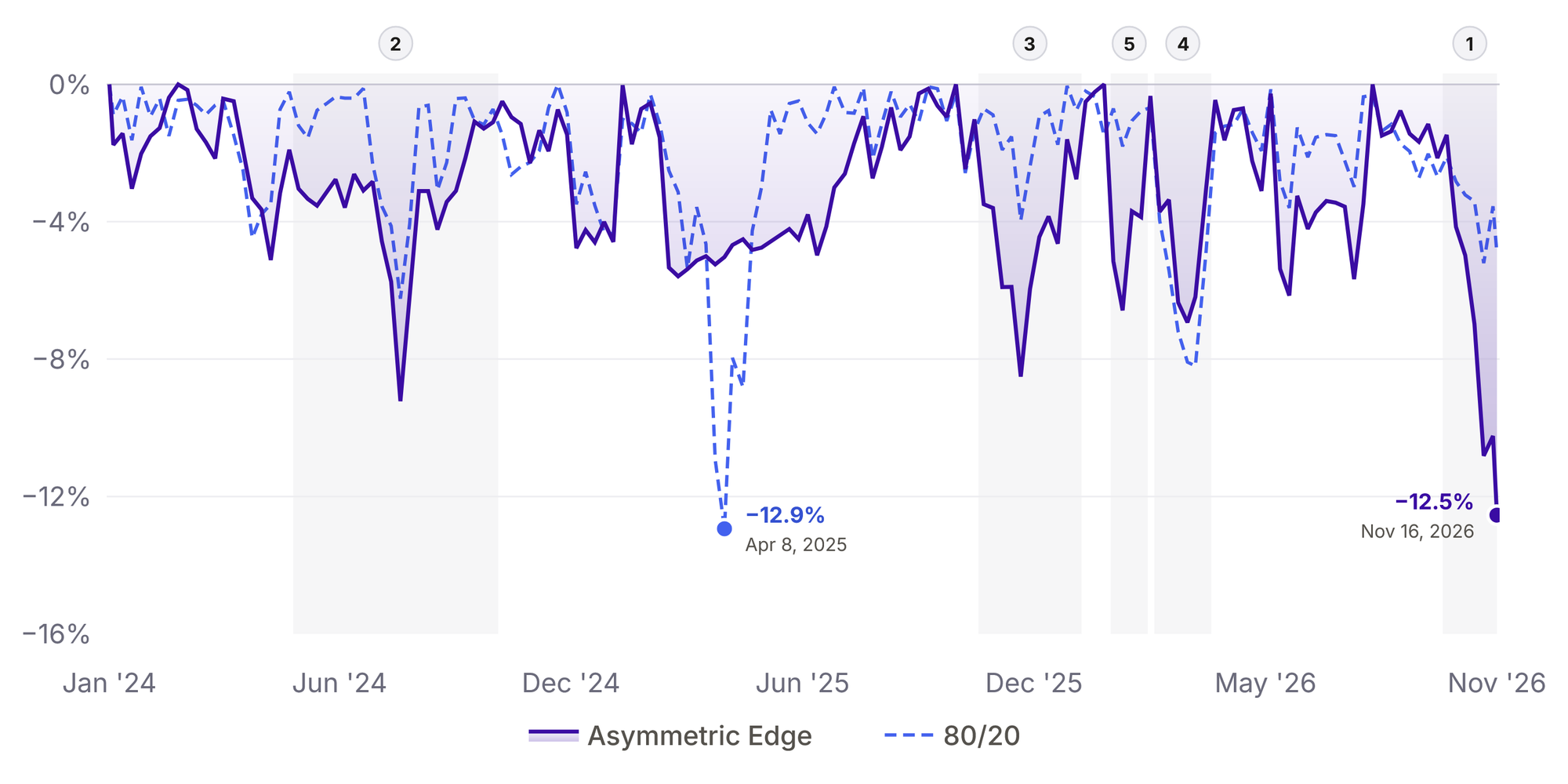
My backtest since 1995 runs the strategy's exact current rules back through market history as if I'd followed them all along. In that backtest, the strategy would have had six declines of more than 10% in 31 years, about one every five years. The largest would have been 15.3%, in 2000. Those results are hypothetical, and they can't say where this decline ends.
My live declines vs. the 80/20 since January 2024
The chart below shows my live record since January 2024, not the backtest.
What I see in my counseling work
Uncertainty sits at the center of much of my work with clients. Many try to avoid the discomfort that comes with it by controlling every part of their lives.
That much control is a costly illusion, and chasing it only creates suffering.
Yet often, when clients are willing to face their fear that so much in life is uncontrollable, something shifts. There's a relief to it, and not being in control turns out to be far less terrifying than they imagined.
So often, it's the fight against a feeling, instead of just letting it happen, that creates so much misery. Emotions come and go. Fighting them can consume a lifetime.
Investing is fraught with uncertainty. No one knows how the stock market will perform next week, let alone over the next year or two.
Even now, after years of investing, part of me wants to take control when I watch my portfolio fall quickly. There's an urge to act—to do something, anything. Underneath it is a vague but palpable fear that something is terribly wrong, but it's a fear I haven't put into words.
What I do instead
Cognitive behavioral therapy (CBT) helps people act without certainty instead of waiting for it. Over-preparing and repeated checking are what CBT calls safety behaviors. They bring relief in the moment but keep the worry going. Even stress-testing my strategy could become a safety behavior if I did it after every down day.
One exercise I use with clients is called decatastrophizing, and it starts with the simple idea that most of our worries are vague. A thought like "something bad is going to happen" feels intimidating, often more so than the real situation, because the mind fills in the blanks.
It works by getting specific, one question at a time. If a falling market has you worried, these are the questions I'd walk through with a client.
What exactly am I afraid of? "The market will keep falling" is vague. "I'll have to work five more years" is specific.
If that happened, what would my life actually look like a month later? A year later?
What would I actually do? Not what I should do, but what I would do.
What would still be okay? The people, income, and options that would still be there.
The point isn't to make the fear go away. Often there's something relieving about just naming the worst-case scenario, even when it's truly awful and the fear is valid. Taking it from vague to specific is one way to reduce uncertainty when uncertainty has begun to feel overwhelming.
I still catch myself wishing I'd gotten out near the October 6th high. But that assumes I could have known October 6th was the high, and no one could.
Accepting that I can't know what comes next has brought relief this month, even a kind of freedom.
Quote of the Month
He who lives by the crystal ball will eat shattered glass. - Ray Dalio
This month's largest moves came from events that were hard to predict, like how the midterms would hit chip stocks and what President Trump would say next on Iran. I don't try to predict events like those, and my strategy doesn't need me to. It shifts toward what's gaining momentum and away from what's stalling, whatever the reason.
Wrap Up
My strategy closed Monday 12.54% below its October 6th high. Even so, I'm less concerned than I was earlier this month.
That comes down to knowing I've done my due diligence. I've put years of research and analysis into building a strategy I believe is robust. The last few weeks have been ugly, but this decline is still smaller than the largest my strategy would have had in my backtest since 1995, though a backtest can't say how far this one goes. So I'm sitting tight and letting things play out, knowing I've done what I can to prepare for whatever comes.
I plan for the worst and hope for the best. My plan was made long before this decline, and it's the same one I follow every month. I stick to it and focus on living my life—being present and accepting what's outside my control.
Embracing uncertainty also leaves room for pleasant surprises.
You'll hear from me next on the morning of November 30th, with my positions for December.
Thanks for reading.

Disclaimer & Disclosure
This newsletter is for informational purposes only and does not constitute financial advice, investment recommendations, or an offer to sell or buy any securities. The content is published as a journal of the author's personal investment activities and is intended for a general audience.
No Investment Advice: The author is not a financial advisor. You should not treat any opinion expressed herein as a specific inducement to make a particular investment or follow a particular strategy, but only as an expression of opinion.
Risk Warning: Investment involves risk, including the possible loss of principal. Past performance is not indicative of future results. No investment strategy or risk management technique can guarantee returns or eliminate risk in any market environment.
Data & Accuracy: Information contained herein has been obtained from sources believed to be reliable, but its accuracy and completeness are not guaranteed. All expressions of opinion are subject to change without notice in reaction to shifting market conditions.
Positions: The author currently holds positions in the securities mentioned in this newsletter. The author may buy or sell these securities at any time without notice.
Copyright: This content is provided solely for the personal use of the subscriber. Any unauthorized copying, forwarding, or distribution of this material is prohibited without prior written consent.